

Local Volume
Images
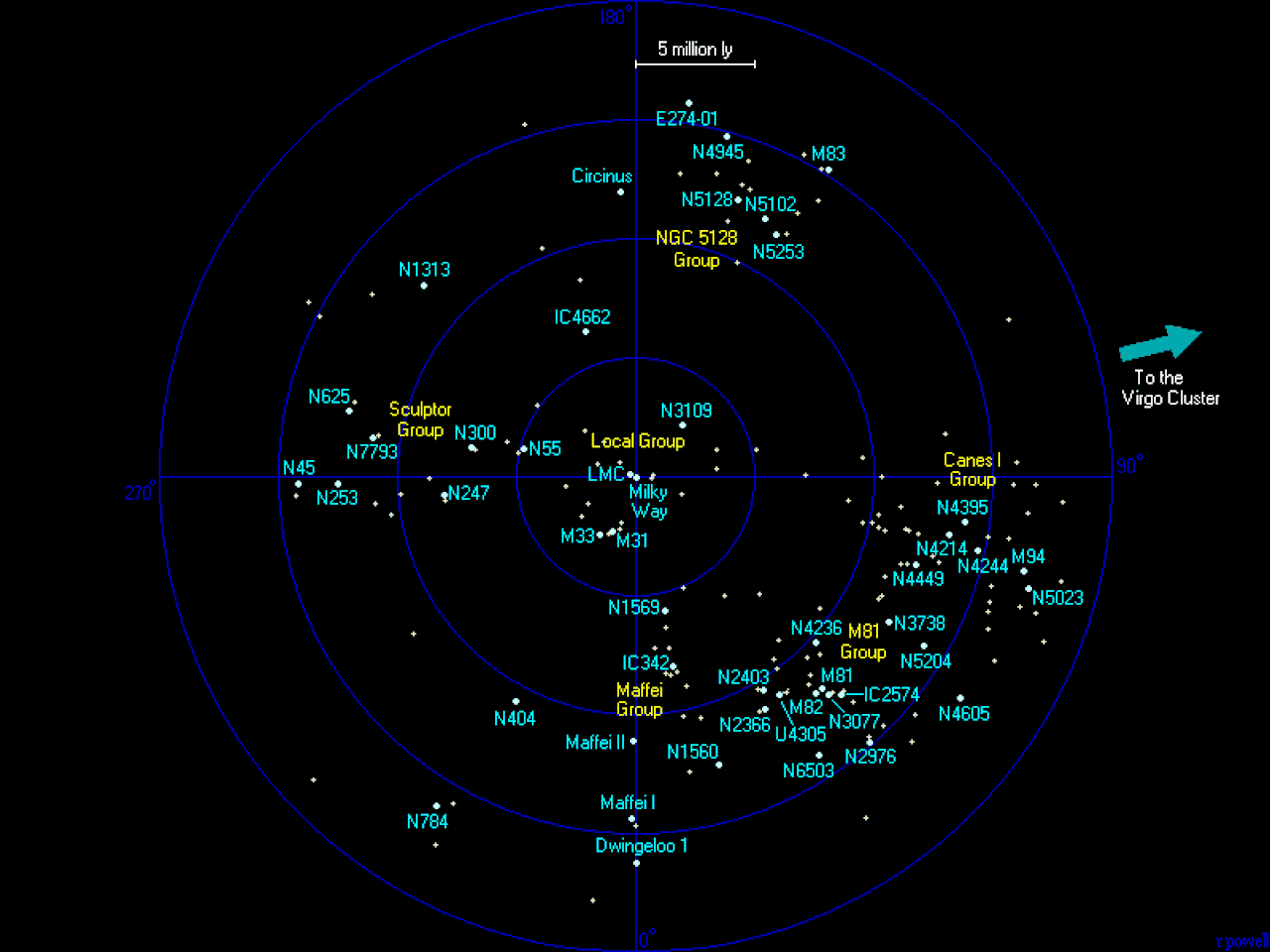
Local Volume


Defining the Local Volume
The Local Volume is defined as a region of space encompassing approximately 100 galaxies, gravitationally bound together. Its diameter is estimated to be around 10 million light-years, placing it within the larger context of the Virgo Supercluster. This collection is not a uniform distribution but rather a complex system dominated by massive spiral galaxies like our own Milky Way and the Andromeda Galaxy (M31), alongside numerous smaller dwarf galaxies, including the Magellanic Clouds.
The space between these galaxies is not a perfect vacuum but is filled with a tenuous intergalactic medium (IGM), primarily composed of ionized hydrogen and helium, along with trace amounts of heavier elements. This IGM plays a crucial role in galactic evolution, acting as a reservoir for star formation and influencing galactic dynamics through ram pressure stripping and accretion. The precise boundaries of the Local Volume are somewhat fluid, often defined by the extent of gravitational influence and the presence of distinct galaxy populations.
Historical Context and Discovery of Galactic Neighbors
The understanding of the Local Volume has evolved significantly over time. Early astronomers recognized the Milky Way as our galaxy but debated the nature of 'nebulae' – fuzzy patches of light in the sky. It wasn't until Edwin Hubble's work in the 1920s, using Cepheid variable stars in the Andromeda Nebula, that it was definitively proven to be a separate galaxy far beyond the Milky Way.
This discovery revolutionized our understanding of the universe's scale. Subsequent surveys, like the Shapley-Ames Catalogue of Bright Galaxies, systematically cataloged nearby galaxies, gradually mapping out the extent and membership of what we now call the Local Group. The identification of dwarf spheroidal galaxies and their tidal interactions with larger galaxies has been a more recent focus, refining our models of galactic structure and dark matter distribution.
Scientific Significance
The Local Volume's proximity makes it an unparalleled laboratory for studying fundamental astrophysical processes. Astronomers can resolve individual stars within nearby galaxies, enabling detailed studies of stellar populations, star formation rates, and the chemical enrichment of galaxies over time. The presence of active galactic nuclei (AGN) in some Local Volume galaxies, though less powerful than in distant quasars, provides opportunities to study supermassive black hole accretion and feedback mechanisms.
Furthermore, the Local Volume serves as a crucial benchmark for cosmological models. By studying the distribution and dynamics of galaxies within it, cosmologists can test theories of structure formation, the nature of dark matter, and the expansion rate of the universe. The relative isolation of the Local Volume from denser superclusters allows for a cleaner study of its internal dynamics, free from overwhelming external gravitational influences.
Dynamics and Evolution
The galaxies within the Local Volume are engaged in a constant gravitational dance. The Milky Way and Andromeda are on a direct collision course, predicted to merge in approximately 4.5 billion years, forming a larger elliptical galaxy. This merger will not be a violent destruction of stars but rather a gradual process of gravitational interaction and rearrangement.
The Magellanic Clouds are currently being tidally disrupted by the Milky Way, leaving trails of gas and stars in their wake. These interactions are vital for understanding galactic evolution, as they can trigger intense bursts of star formation and redistribute matter within galaxies. Studying these ongoing processes provides direct observational evidence for theoretical models of galaxy mergers and accretion, which are fundamental to understanding how galaxies grow and change over cosmic epochs.
Observational Techniques and Future Prospects
Observing the Local Volume relies on a suite of advanced astronomical tools. Optical telescopes, both ground-based and space-based (like Hubble and James Webb Space Telescopes), are essential for resolving stars, nebulae, and galactic structures. Radio telescopes are crucial for detecting the neutral hydrogen gas that traces galactic disks and tidal streams, as well as for studying AGN. Spectroscopic observations allow astronomers to measure the velocities of stars and gas, providing insights into galactic rotation curves and the distribution of dark matter. Future research will focus on refining distance measurements to galaxies within the Local Volume, improving our understanding of the Hubble constant, and continuing to map the distribution and properties of the intergalactic medium.
Missions like the Gaia spacecraft are providing unprecedented astrometric data for stars within the Milky Way and nearby dwarf galaxies, further enhancing our comprehension of our local cosmic environment.
Go deeper
Frequently Asked Questions
What is the Local Volume?+
Which big galaxies are in the Local Volume?+
What is the space between the galaxies called?+
When will the Milky Way and Andromeda collide?+
Why do scientists study the Local Volume?+
Based on content from Wikipedia · Licensed under CC BY-SA 4.0