

The Little Red Dot: A Tiny Star's Big Story
Images

Little red dot (astronomical object)


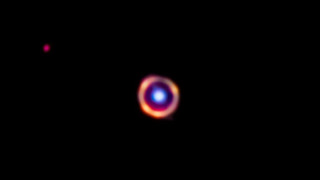


The Dominance of Red Dwarfs
Red dwarfs, classified as M-type main-sequence stars, represent the overwhelming majority of stars in the Milky Way galaxy, constituting an estimated 70-80%. Their prevalence stems from their formation process, where less massive clouds of gas and dust collapse under gravity. This results in stars with masses typically ranging from 0.08 to 0.6 solar masses.
Their lower mass dictates their fundamental properties: cooler surface temperatures (around 2,000 to 3,500 Kelvin), lower luminosity (often less than 1% of the Sun's), and a characteristic reddish hue. Unlike larger stars that undergo convective and radiative zones, many red dwarfs are fully convective, meaning their material churns continuously. This thorough mixing allows them to utilize a much larger fraction of their hydrogen fuel over their immense lifespans, a key factor in their longevity and a significant differentiator from stars like our Sun.
Stellar Evolution and the Long Burn of Red Dwarfs
The evolutionary path of a red dwarf is characterized by its extraordinary longevity. Beginning their lives in stellar nurseries, these stars initiate nuclear fusion of hydrogen into helium in their cores. However, due to their low mass and the resulting lower core pressure and temperature, this fusion process occurs at an exceptionally slow rate.
This gradual energy production means red dwarfs consume their fuel over timescales far exceeding the current age of the universe. While larger stars might live for millions or a few billion years, red dwarfs are projected to shine for tens of trillions of years. They do not evolve into red giants or white dwarfs in the same manner as Sun-like stars; instead, they are expected to slowly contract and heat up over their lifetimes, eventually becoming white dwarfs composed primarily of helium after exhausting their fuel, a process that will take an incomprehensibly long time.
Habitability Around Red Dwarfs
The sheer number of red dwarfs and their extended lifespans make them compelling targets in the search for extraterrestrial life. It is widely believed that most red dwarfs host planetary systems, with many potentially residing within their habitable zones – the region where liquid water could exist on a planet's surface. However, habitability around red dwarfs presents unique challenges.
These stars are prone to powerful stellar flares, which can strip away planetary atmospheres and bombard surfaces with harmful radiation. Planets in the habitable zone must orbit very closely to their red dwarf host, increasing their exposure to these flares and tidal locking, where one side perpetually faces the star. Despite these hurdles, the vast number of red dwarf systems and the immense timescales involved offer significant potential for life to arise and persist, making them a focal point for astrobiological research and exoplanet detection missions.
Observational Techniques and Future Prospects
Detecting and characterizing red dwarfs and their exoplanets requires specialized observational techniques. Their low luminosity makes them difficult to observe directly, especially at great distances. However, their abundance means that even nearby red dwarfs are frequent targets for surveys.
Methods like the transit method, where a planet passing in front of its star causes a dip in brightness, and the radial velocity method, which detects the wobble of a star caused by an orbiting planet's gravity, are crucial. Missions like NASA's Transiting Exoplanet Survey Satellite (TESS) are specifically designed to survey nearby stars, including many red dwarfs, for exoplanets. Future telescopes, such as the James Webb Space Telescope and ground-based observatories, aim to analyze the atmospheres of these exoplanets, searching for biosignatures – indicators of life – which could revolutionize our understanding of life's prevalence in the cosmos.
See also
Based on content from Wikipedia · Licensed under CC BY-SA 4.0