

List of Countries by How Much Money They Make!
Images

GDP PPP 2009 2014
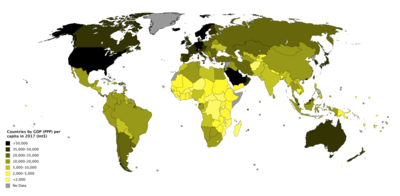


Deconstructing GDP (PPP)
Gross Domestic Product (GDP) is the foundational metric for a nation's economic output. However, when comparing economies across borders, nominal GDP, calculated using market exchange rates, can be highly misleading. This is where Purchasing Power Parity (PPP) becomes indispensable.
PPP is an economic theory that states that the exchange rate between two currencies should equal the ratio of the two countries' price levels of a fixed basket of goods and services. Essentially, it adjusts for the fact that prices for goods and services vary significantly between countries due to differences in labor costs, taxes, and other economic factors. For instance, a dollar might buy a meal in a developing nation that would cost many times that in a developed one.
By using PPP, economists create an 'international dollar' that offers a more accurate comparison of the real volume of goods and services produced and consumed, thereby providing a better gauge of domestic market size and living standards. Organizations like the International Monetary Fund (IMF) and the World Bank are primary sources for these estimates, often projecting figures for upcoming years based on current economic trends.
The Genesis of Economic Metrics
The concept of measuring a nation's wealth has evolved dramatically. Early forms of economic accounting focused on tangible assets like land and precious metals. The development of GDP as a comprehensive measure of economic activity gained traction in the mid-20th century, largely driven by the need to understand national economies during and after major global events like the Great Depression and World War II.
Simon Kuznets is often credited with pioneering GDP measurement. However, as globalization increased, the limitations of using simple exchange rates for international comparisons became apparent. The International Comparison Program (ICP), a global statistical initiative, has been instrumental in developing and refining PPP methodologies since the 1970s.
These programs conduct extensive price surveys to create representative baskets of goods and services, ensuring that PPP calculations are based on empirical data rather than just theoretical exchange rates. The ongoing refinement reflects a continuous effort to improve the accuracy and comparability of global economic data.
The Global Scorecard
GDP (PPP) serves as a critical lens through which we view global economic disparities and development trajectories. A higher GDP (PPP) generally correlates with a higher standard of living, greater purchasing power for citizens, and increased capacity for investment in public services such as healthcare, education, and infrastructure. This makes it a vital tool for policymakers, international organizations, and researchers.
For instance, the United Nations utilizes PPP data extensively in constructing the Human Development Index (HDI), a composite measure that goes beyond mere income to assess overall well-being. It also informs global poverty thresholds, helping to identify populations in need and guide humanitarian aid efforts. While PPP is excellent for assessing domestic economic conditions, it has limitations.
It is less effective for measuring international financial flows, trade balances, or the quality of identical goods across different countries. Nevertheless, its ability to provide a more realistic picture of economic parity makes it an indispensable metric in global economic analysis.
The Mechanics of Measurement
The calculation of GDP (PPP) involves a sophisticated, multi-step process. It begins with collecting detailed national accounts data for nominal GDP. Simultaneously, extensive price surveys are conducted across participating countries, covering a wide array of goods and services, both tradable (like electronics) and non-tradable (like haircuts or local transportation).
These prices are then used to calculate PPP exchange rates, which represent the number of units of a country's currency required to purchase the same basket of goods and services that one unit of a base currency (often the US dollar) could buy in the base country. The nominal GDP is then divided by this PPP exchange rate to arrive at the GDP (PPP). For example, if a country's nominal GDP is $1 trillion and its PPP exchange rate is 0.5 international dollars per local dollar, its GDP (PPP) would be $2 trillion in international dollars.
This methodology, while robust, requires significant statistical coordination and relies on the accuracy of the price data collected. Different institutions like the IMF and the World Bank may use slightly different methodologies or update cycles, leading to variations in reported figures.
Navigating the Data Landscape
The list of countries by GDP (PPP) is not a single, static document but rather a compilation from various reputable sources, primarily the International Monetary Fund (IMF) and the World Bank. These institutions provide estimates and projections, often updated annually or biannually. The IMF's International Financial Statistics (IFS) database and the World Bank's data repositories are key sources.
It's important to note that these figures are estimates and can vary slightly between sources due to differences in data collection methodologies, the specific year of the estimate, and the inclusion of non-sovereign economic entities like Hong Kong or Puerto Rico. The CIA World Factbook also provides GDP (PPP) data, often with a slightly different historical baseline. Understanding these nuances is crucial for accurate interpretation.
For instance, a country's rank might shift depending on which institution's data you consult and for which specific year, highlighting the dynamic nature of global economic performance.
See also
Frequently Asked Questions
What is GDP (PPP) and why is it useful?+
How does PPP help compare countries?+
Which organizations provide GDP (PPP) data?+
Why is GDP (PPP) important for living standards?+
What are some limits of PPP?+
Based on content from Wikipedia · Licensed under CC BY-SA 4.0