

Lightning
Images
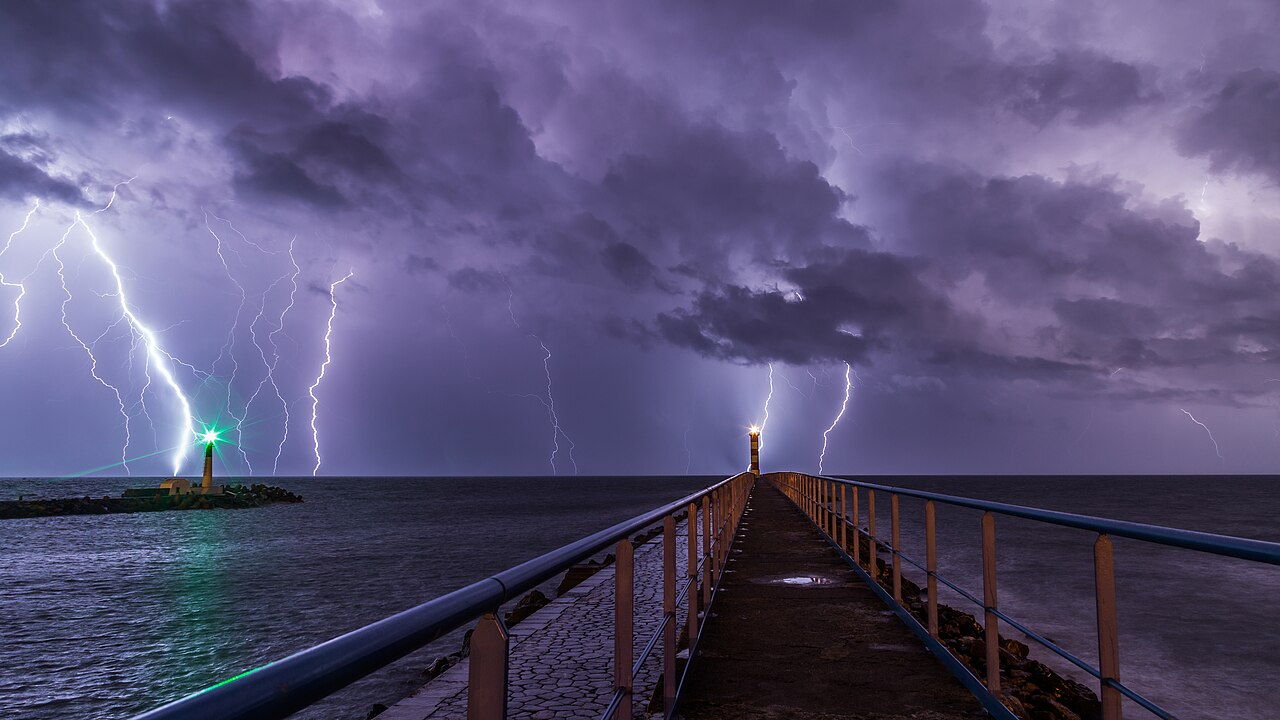
Lightning


The Mechanics of Atmospheric Electricity
Lightning is the macroscopic manifestation of electrostatic discharge within the atmosphere, occurring between electrically charged regions. These regions can be within a single cloud (intra-cloud lightning), between two clouds (cloud-to-cloud lightning), or between a cloud and the ground (cloud-to-ground lightning). The process is initiated by charge separation within convective clouds, primarily thunderstorms, driven by collisions between hydrometeors (ice crystals, graupel, and supercooled water droplets).
These collisions lead to the transfer of charge, typically resulting in a positive charge accumulation in the upper regions of the cloud and a negative charge in the lower-middle regions. When the electric field strength exceeds the dielectric breakdown strength of air, a cascade of events unfolds. A faint, invisible 'stepped leader' propagates downwards from the cloud in discrete steps, ionizing a channel through the air.
As this leader approaches the ground, positive streamers ascend from elevated objects. When a leader and streamer connect, a highly conductive channel is established, and a massive surge of current, the 'return stroke,' rushes upwards, producing the visible flash and intense heating. This rapid heating causes an explosive expansion of air, generating the acoustic shockwave known as thunder.
Historical Perceptions and Scientific Unraveling
Humanity's relationship with lightning has evolved from primal fear and mythological attribution to rigorous scientific inquiry. Ancient civilizations often viewed lightning as a divine weapon or expression of celestial power, with figures like Zeus in Greek mythology and Thor in Norse mythology wielding thunderbolts. The scientific understanding of lightning began to take root during the Age of Enlightenment. Benjamin Franklin's groundbreaking experiments in the mid-18th century, most famously his kite experiment (circa 1752), provided the first empirical evidence linking lightning to terrestrial electricity.
His work demonstrated that lightning was not supernatural but a natural electrical phenomenon, which spurred further investigations into atmospheric electricity. Subsequent research, involving sophisticated instruments and theoretical models, has progressively unveiled the intricate physics governing charge generation, propagation, and discharge, transforming our comprehension from mere observation to detailed mechanistic understanding.
Ecological Roles and Global Significance
Beyond its dramatic visual and auditory presence, lightning exerts significant influence on Earth's climate and ecosystems. It is a critical component of the global atmospheric electrical circuit, a continuous flow of electrical charge that helps maintain electrical neutrality between the ionosphere and the Earth's surface. The immense energy released, averaging between 200 megajoules and 7 gigajoules, has profound effects.
The extreme temperatures, reaching approximately 30,000 °C (54,000 °F), not only create thunder but also play a role in atmospheric chemistry. Lightning can fix atmospheric nitrogen, converting it into nitrates that are then carried to the soil by precipitation, acting as a natural fertilizer essential for plant growth. Furthermore, lightning is a primary natural ignition source for wildfires, a process crucial for the ecological dynamics of many biomes, promoting seed germination and clearing out undergrowth.
The World Meteorological Organization recognizes lightning as an Essential Climate Variable, underscoring its importance in climate studies.
The Physics of the Flash and Thunder
The visual spectacle of lightning is a consequence of the rapid heating and subsequent expansion of air along the lightning channel. The return stroke, carrying immense current, heats the air to temperatures far exceeding that of the sun's surface. This superheated plasma expands outwards at supersonic speeds, creating a powerful shockwave.
As this shockwave propagates through the atmosphere and slows down to the speed of sound, it becomes audible as thunder. The characteristic rumbling sound is due to the combined effect of multiple sound waves generated along the entire length of the lightning channel. The duration and intensity of the thunder depend on the length and power of the lightning strike, as well as atmospheric conditions like temperature and humidity, which affect sound propagation.
The entire process, from the initial stepped leader to the final thunderclap, occurs within seconds, showcasing the incredible speed and power of this natural phenomenon.
Go deeper
Frequently Asked Questions
What is lightning?+
How does lightning start inside a thunderstorm?+
Why do we hear thunder after a lightning flash?+
How does lightning help plants grow?+
Why do people think lightning is dangerous?+
Based on content from Wikipedia · Licensed under CC BY-SA 4.0