

Licinius
Images

Licinius & Constantine montage


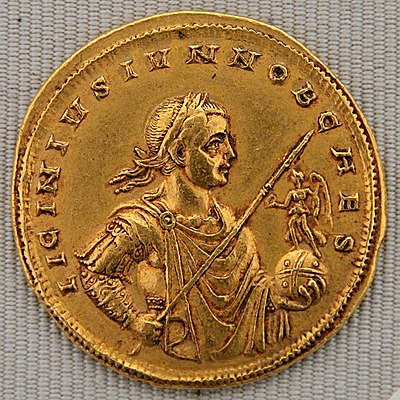


Ascension and the Tetrarchy's Shadow
Born around 265 AD, Valerius Licinianus Licinius emerged as a significant military figure within the Roman Empire. His rise to power was intrinsically linked to the complex political landscape of the early 4th century, a period still influenced by the Tetrarchy, a system of rule by four emperors. Licinius was proclaimed Augustus (emperor) in 308 AD, a title that solidified his position as a senior ruler.
For much of his reign, he was a colleague, and later a rival, to Constantine I. Their shared imperial responsibilities, particularly in the eastern and western halves of the empire respectively, initially fostered a degree of cooperation, but the inherent instability of shared rule in such a vast territory soon became apparent. Licinius's early career was characterized by military success and political maneuvering, positioning him as a key player in the empire's ongoing power dynamics.
The Edict of Milan
Licinius's most enduring contribution to history is his co-authorship of the Edict of Milan in 313 AD. Issued jointly with Constantine I, this decree was a watershed moment for religious freedom in the Roman Empire. Prior to this edict, Christians had endured periods of intense persecution.
The Edict of Milan officially granted religious toleration, meaning individuals could worship as they pleased without fear of state reprisal. This was not merely a passive acceptance but an active policy that allowed for the restitution of confiscated Christian property. While Constantine is often more prominently credited, Licinius's role was crucial, reflecting a pragmatic approach to managing the empire's diverse religious populace and perhaps a genuine belief in religious liberty.
This edict fundamentally altered the trajectory of Christianity, enabling its rapid growth and eventual dominance.
The Unraveling of Co-Rule
The initial collaboration between Licinius and Constantine proved to be fragile. As their respective spheres of influence solidified, their ambitions began to clash. The Edict of Milan, while a symbol of cooperation, could not mask the underlying power struggle.
Licinius, ruling primarily from the East, and Constantine, dominant in the West, became increasingly antagonistic. Their rivalry was not simply about personal power but also about the future direction and administration of the Roman Empire. This escalating tension led to a series of conflicts, transforming their former alliance into a bitter and destructive war.
The empire was effectively divided, with each emperor seeking to consolidate his authority and eliminate the other as a threat.
The Battle of Chrysopolis and Licinius's Demise
The culmination of their protracted conflict arrived in 324 AD with the Battle of Chrysopolis. Constantine's superior military strategy and forces led to a decisive victory over Licinius. This defeat was catastrophic for Licinius, effectively ending his imperial ambitions and his reign.
Captured and stripped of his power, Licinius became a liability to Constantine, who was now the sole emperor of a unified Roman Empire. In a move that underscored the brutal realities of imperial politics, Constantine ordered Licinius's execution later that year. While Licinius's reign was ultimately cut short and ended tragically, his role in establishing religious toleration through the Edict of Milan left an indelible mark on Western civilization, forever changing the relationship between state and religion.
See also
Frequently Asked Questions
Who was Licinius?+
What was the Edict of Milan?+
Why did Licinius and Constantine fight?+
What happened to Licinius after the Battle of Chrysopolis?+
Did Licinius help Christians?+
Based on content from Wikipedia · Licensed under CC BY-SA 4.0