

Lewis Chessmen
Images

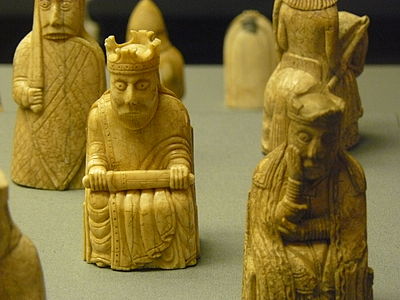
Beserker, Lewis Chessmen, British Museum




The Enigmatic Origins and Craftsmanship of the Lewis Chessmen
Discovered in 1831 on the Isle of Lewis in Scotland's Outer Hebrides, the Lewis chessmen are a collection of 12th-century game pieces, predominantly carved from walrus ivory. Their precise origin remains a subject of scholarly debate, with theories pointing towards Scandinavia, particularly Norway, due to the prevalence of walrus ivory and stylistic similarities to Norse art.
Alternatively, they may have been crafted in Scotland itself, reflecting local artistic traditions and trade connections. The craftsmanship is remarkable; each piece is intricately detailed, showcasing distinct facial expressions, hairstyles, and attire of the period. The knights are depicted not on horses but on mythical beasts, and the bishops are often shown with exaggerated gestures, possibly a commentary on clerical figures or a unique artistic convention.
The kings and queens exude regal authority, while the warders, the pieces equivalent to rooks, are portrayed as formidable warriors. This level of detail transforms them from mere game pieces into significant cultural artifacts, providing invaluable data for art historians and archaeologists studying medieval society.
Socio-Economic and Cultural Significance in the Medieval World
The Lewis chessmen are more than just ancient toys; they are windows into the socio-economic landscape of the medieval era. The use of walrus ivory signifies extensive trade networks, as walruses were primarily found in Arctic regions. This suggests that the pieces were either imported or crafted by artisans who had access to these valuable materials, indicating a level of wealth and connectivity for the society that possessed them. Chess itself was a game of strategy and intellect, popular among the nobility and educated classes.
The presence of multiple chess sets and other game pieces (tablemen) in the hoard suggests that leisure activities and strategic thinking were integral to the lives of the elite. The sheer number of pieces found, though incomplete, hints at the possibility of multiple sets being commissioned or owned. Their eventual burial as a hoard raises questions about their intended purpose: were they hidden for safekeeping during times of conflict, or were they part of a ritualistic deposit?
The mystery surrounding their burial only adds to their profound historical significance.
Archaeological Context and Preservation Challenges
The discovery of the Lewis chessmen in a sand dune near Uig was serendipitous, and the archaeological context of their find was not meticulously recorded, which complicates definitive interpretations. The hoard originally contained 94 objects, comprising 78 chess pieces, 14 tablemen, and a belt buckle. Today, the majority of these pieces (82) are housed at the British Museum in London, while 11 are displayed at the National Museum of Scotland in Edinburgh.
The preservation of walrus ivory over centuries presents unique challenges. Ivory is susceptible to drying, cracking, and discoloration. Museum conservators employ specialized techniques to maintain the stability of these delicate artifacts, ensuring their survival for future generations.
The recent identification and sale of a previously unknown 'warder' piece for a substantial sum (£735,000) underscores their enduring value and the ongoing potential for new discoveries related to this collection.
Enduring Legacy and Modern Relevance
The Lewis chessmen continue to captivate the public imagination, serving as powerful symbols of medieval history and artistry. They are frequently referenced in popular culture, appearing in books, films, and exhibitions, solidifying their status as iconic historical artifacts. Their incomplete nature fuels ongoing research and speculation, with efforts to reconstruct potential original sets and understand the full scope of their creation and use.
The pieces represent a tangible link to the past, allowing us to connect with the people who played with them, the artisans who crafted them, and the world they inhabited. In an era of digital entertainment, the Lewis chessmen remind us of the enduring appeal of physical games and the rich history of human creativity and strategic thought. Their study contributes to our understanding of medieval trade, social structures, artistic development, and the universal human desire for play and competition.
See also
Based on content from Wikipedia · Licensed under CC BY-SA 4.0