

Lewis Carroll
Images
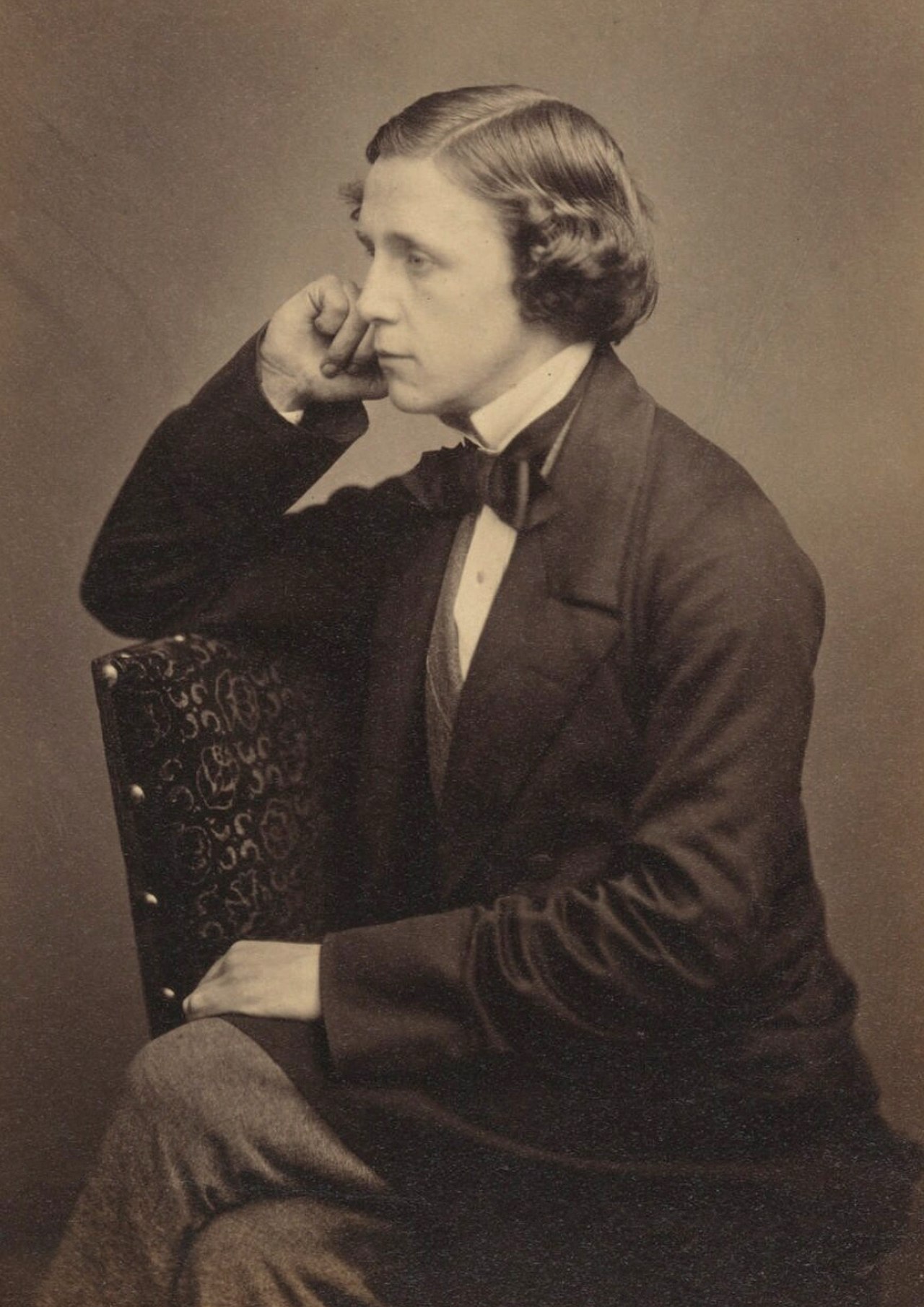
Lewis Carroll
Charles Dodgson's Dual Existence
Charles Lutwidge Dodgson (1832–1898) led a life marked by a fascinating duality. Primarily known to the world as Lewis Carroll, he was an accomplished mathematician, logician, and photographer associated with Christ Church, Oxford, for most of his adult life. His academic pursuits, including his role as an Anglican deacon, were a significant part of his identity.
However, it was under his pen name that he achieved enduring fame, crafting narratives that defied the conventions of Victorian literature. His most celebrated works, 'Alice's Adventures in Wonderland' (1865) and 'Through the Looking-Glass' (1871), emerged from a period of intense creative output, often linked to his friendships with the children of Oxford's academics, most notably Alice Liddell. This deliberate separation between his public persona and his literary pseudonym allowed him to explore imaginative realms while navigating the more rigid social and academic structures of his time.
The Algorithmic Architecture of Wonderland's Absurdity
Carroll's profound understanding of mathematics and logic is not merely a biographical footnote; it is intrinsically woven into the fabric of his most famous works. The seemingly chaotic and nonsensical events in Wonderland are often underpinned by a rigorous, albeit playful, adherence to logical principles. Carroll's fascination with formal logic, paradoxes, and word puzzles directly informed the dialogue and scenarios presented in his stories.
For example, the Mad Hatter's tea party, with its perpetual state of being 'six o'clock,' can be seen as a playful exploration of temporal paradoxes. Furthermore, his invention of the 'Doublets' puzzle, a word-transformation game, highlights his interest in structured linguistic play. This intellectual foundation elevates his 'literary nonsense' beyond mere silliness, offering layers of meaning that reward careful analysis and connect directly to his published mathematical works on logic.
Pioneering Literary Nonsense and Linguistic Innovation
Lewis Carroll is widely recognized as a master of literary nonsense, a genre that thrives on linguistic invention and the subversion of expectations. His poems, such as 'Jabberwocky' (1871) and 'The Hunting of the Snark' (1876), are prime examples, featuring portmanteau words and neologisms that create a unique sonic and semantic landscape. 'Jabberwocky,' in particular, is celebrated for its evocative made-up words like 'slithy' and 'toves,' which, despite their unfamiliarity, conjure vivid images.
This linguistic dexterity, coupled with his penchant for puns, riddles, and logical fallacies presented as dialogue, made his writing distinct and influential. His ability to manipulate language and meaning challenged the literary norms of his era, paving the way for future generations of experimental writers and solidifying his status as a pivotal figure in literary history.
Enduring Influence and Cultural Resonance
The impact of Lewis Carroll's literary creations continues to resonate profoundly in contemporary culture. 'Alice's Adventures in Wonderland' and 'Through the Looking-Glass' have transcended their origins as children's books to become seminal works of art, influencing countless adaptations across film, theatre, visual arts, and even philosophy. The characters and concepts introduced by Carroll have entered the global lexicon, symbolizing the surreal, the illogical, and the whimsical.
The existence of dedicated international societies and the ongoing academic study of his works underscore their lasting significance. Carroll's legacy is that of an innovator who demonstrated the profound possibilities of imagination, logic, and language, proving that playful exploration can yield enduring cultural and intellectual treasures.
Key Contributions and Lasting Impact
Lewis Carroll's contributions extend beyond his imaginative narratives. As a mathematician, he published works on geometry, algebra, and logic, demonstrating a rigorous intellectual framework that informed his creative output. His work on logic puzzles, like 'Doublets,' showcased his ability to translate complex ideas into accessible formats.
The enduring appeal of his stories lies in their ability to engage readers on multiple levels, offering simple entertainment for children while providing intellectual fodder for adults and scholars. His influence can be seen in the development of surrealism in art and literature, and his exploration of consciousness and identity continues to be a subject of critical interest. Carroll's unique synthesis of mathematical precision and boundless fantasy has cemented his place as one of literature's most original and influential voices.
Go deeper
Frequently Asked Questions
Who was Lewis Carroll?+
What books did he write?+
Why is he called a mathematician?+
What is the poem "Jabberwocky"?+
How are his stories still important today?+
Based on content from Wikipedia · Licensed under CC BY-SA 4.0