

Lamarckism: How Animals Change!
Images

File:Tegula excavata (Lamarck, 1822) (4190506806).jpg




The Lamarckian Framework
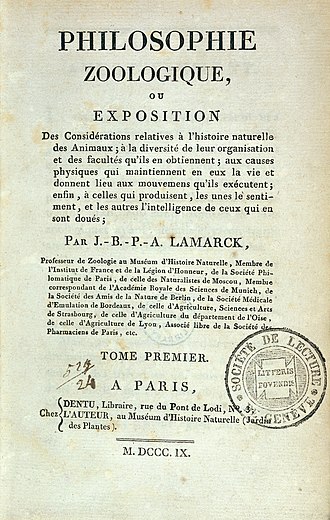
Lamarckism, formally known as Lamarckian inheritance or soft inheritance, is a theory of evolution primarily associated with the French naturalist Jean-Baptiste Lamarck (1744–1829). His seminal work, 'Philosophie Zoologique' (1809), proposed a two-part mechanism for evolutionary change. Firstly, he posited an intrinsic 'drive towards complexity' or orthogenesis, suggesting that life naturally progresses from simpler to more complex forms.
Secondly, and more famously, he championed the 'inheritance of acquired characteristics.' This principle asserted that traits an organism develops during its lifetime through the use or disuse of organs or body parts could be passed directly to its progeny. Lamarck believed that environmental pressures would lead to changes in an organism's needs, prompting new behaviors. These behaviors would, in turn, lead to the development or atrophy of specific body parts, and these acquired modifications would then be heritable.
This was a radical departure from earlier static views of life and offered a dynamic, albeit ultimately incorrect, explanation for the diversity and adaptation of species.
The Giraffe's Neck and the Rise of Darwin
The most iconic illustration of Lamarck's theory is the evolution of the giraffe's long neck. Lamarck argued that ancestral giraffes possessed shorter necks. Faced with the need to reach higher foliage, they would stretch their necks.
This constant effort would lead to a slight elongation of the neck within an individual's lifetime. This acquired trait, the slightly longer neck, would then be passed on to their offspring. Over successive generations, this cumulative stretching and inheritance would result in the exceptionally long necks observed in modern giraffes.
While Lamarck's explanation was intuitive, it was eventually challenged and largely superseded by Charles Darwin's theory of evolution by natural selection. Darwin's model emphasized random variation and differential survival and reproduction, where individuals with pre-existing advantageous traits were more likely to survive and pass those traits on, rather than traits acquired through effort.
The Scientific Scrutiny and Refutation of Lamarckism
The scientific community's rejection of Lamarckism was a gradual process, significantly influenced by advancements in genetics and experimental biology. A pivotal moment was August Weismann's experiments in the late 19th century, which involved surgically removing the tails of mice for numerous generations. Weismann found that the offspring continued to be born with tails, seemingly disproving the inheritance of acquired characteristics.
Although his experiment is now understood to have limitations (it didn't test 'use and disuse' directly), it contributed to the prevailing view that acquired traits were not heritable. The discovery of genes and the understanding of DNA as the primary carrier of hereditary information solidified this view. Mendelian genetics provided a robust framework for inheritance, explaining how traits are passed down through discrete units (genes) from parents to offspring, and these genes are not altered by an organism's life experiences in the way Lamarck proposed.
Echoes of Lamarck
Despite its historical refutation as a primary mechanism of evolution, Lamarckism has experienced a resurgence of interest due to discoveries in epigenetics. Epigenetics studies heritable changes in gene expression that occur without altering the underlying DNA sequence. It has been demonstrated that environmental factors, such as diet, stress, or exposure to toxins, can induce epigenetic modifications that can sometimes be transmitted across generations.
For instance, studies have shown that famine experienced by one generation can affect the metabolic health of their grandchildren. While this 'transgenerational epigenetic inheritance' is not direct inheritance of acquired physical characteristics in the Lamarckian sense, it does show that an organism's life experiences can indeed influence the traits of its descendants in ways not predicted by classical genetics. The inheritance of the hologenome (an organism's genome plus its associated microbial genomes) also presents complex interactions that can be seen as having Lamarckian-like effects, though driven by Darwinian mechanisms.
Go deeper
Frequently Asked Questions
What is Lamarckism?+
How did Lamarck explain giraffes getting long necks?+
Why did scientists stop believing in Lamarckism?+
What did Weismann's experiment show?+
Is Lamarckism still useful today?+
Based on content from Wikipedia · Licensed under CC BY-SA 4.0