

La Défense: Paris's Super Tall City!
Images

Le CNIT de la défense


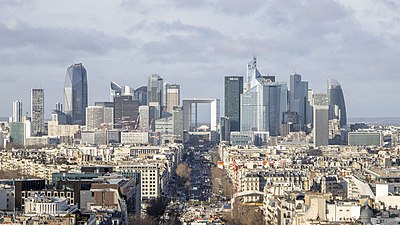
The Genesis and Urban Planning of a Modern Business Hub
La Défense stands as a testament to deliberate urban planning, conceived as a modern extension of Paris's historic axis. Unlike organic urban growth, this district was purpose-built to consolidate business activities west of the city center, beginning its significant development in the mid-20th century. Spanning 560 hectares, it was designed to accommodate a massive workforce of 180,000 daily commuters, featuring a dense concentration of 72 glass and steel structures, including 20 completed skyscrapers.
This deliberate design aimed to create a functional and visually striking business environment, integrating office spaces with residential areas and public amenities to foster a dynamic urban ecosystem. The district's strategic location at the western end of the Axe historique visually connects contemporary commerce with Paris's rich historical narrative.
Economic Powerhouse and Architectural Innovation
As Europe's largest purpose-built business district, La Défense is a critical economic engine for France. It houses a vast amount of office space, totaling 3,500,000 square meters, attracting numerous national and international corporations. The architectural landscape is characterized by bold, modern designs, with skyscrapers that push the boundaries of height and engineering.
This concentration of corporate headquarters and financial institutions underscores its role as a global business hub. The district's economic vitality is further supported by its extensive infrastructure, including a major transportation network that facilitates the daily influx of workers and visitors, making it a crucial component of the Paris metropolitan economy.
A Multifaceted Urban Experience
La Défense transcends its identity as a mere business district by offering a rich tapestry of urban life and cultural experiences. The Westfield Les Quatre Temps shopping mall is a significant retail and leisure destination, boasting 220 stores, 48 restaurants, and a large cinema complex, demonstrating a commitment to providing amenities for both workers and residents. The district is also home to a permanent population of 50,000 residents and 75,000 students, fostering a sense of community and ensuring activity beyond typical business hours.
Furthermore, the presence of an open-air museum and public art installations transforms the urban landscape into a cultural venue, inviting exploration and engagement.
Infrastructure, Connectivity, and Cultural Landmarks
The district's functionality is underpinned by sophisticated infrastructure, including a central orbital motorway and extensive public transport links, most notably the RER A train line, which connects it seamlessly to central Paris and surrounding suburbs. This connectivity is vital for managing the daily flow of people. A major landmark is the Paris La Défense Arena, inaugurated in 2017, which stands as Europe's largest indoor arena, capable of hosting major sporting events and concerts, further cementing La Défense's status as a significant cultural and entertainment destination.
The Grande Arche, a monumental arch structure, serves as a focal point and a symbol of the district's modern ambition.
Governance, Demographics, and Future Development
La Défense is managed by the EPADESA (Établissement public d'aménagement de La Défense Seine Arche), a public development agency responsible for its planning, management, and promotion. This centralized governance ensures a cohesive vision for the district's evolution. Demographically, it's a diverse area, attracting a global workforce and a significant student population, contributing to its cosmopolitan atmosphere.
The district continues to evolve, with ongoing projects aimed at enhancing its sustainability, public spaces, and integration with neighboring areas, ensuring its relevance as a leading European business and urban center for decades to come.
See also
Based on content from Wikipedia · Licensed under CC BY-SA 4.0