

Kingdom of Scotland
Images

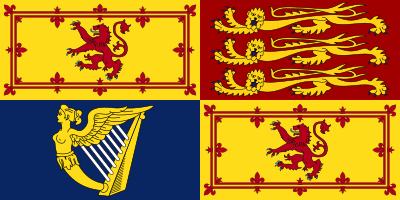
Arms of the United Kingdom in Scotland (1801-1816)


Geopolitical Landscape
The Kingdom of Scotland existed as a sovereign state occupying the northern third of the island of Great Britain. Its geography was a defining characteristic, bordered by the North Sea to the east and the vast Atlantic Ocean to the north and west, with the North Channel and Irish Sea to the southwest. This extensive coastline facilitated maritime trade and defense but also exposed it to external influences, including Norse rule over the Hebrides and Northern Isles, which were eventually incorporated in 1266 and 1472 respectively.
To the south, Scotland shared a land border with the Kingdom of England, a relationship that was often characterized by intermittent conflict, most notably the protracted Wars of Scottish Independence. The territory of the kingdom, after territorial adjustments like the capture of Berwick by England in 1482, largely corresponded to modern-day Scotland. Internally, the landscape was broadly divided into the Highlands and the Lowlands, each with distinct environmental challenges and socio-economic structures.
The Highlands, for instance, faced a shorter growing season, exacerbated by periods like the Little Ice Age, impacting population density and agricultural output.
Chronicles of Sovereignty
Traditionally founded in 843, the Kingdom of Scotland navigated centuries of independent rule, marked by both consolidation and expansion. Its history is punctuated by significant political and military events, including the fierce assertion of independence against English encroachment during the Wars of Scottish Independence. The kingdom's territorial integrity evolved, culminating in the 15th century with its boundaries closely resembling those of modern Scotland.
A pivotal moment occurred in 1603 with the Union of the Crowns, when James VI of Scotland inherited the English throne, uniting the two kingdoms under a single monarch while maintaining separate parliaments and legal systems. This personal union laid the groundwork for the eventual political union. In 1707, under Queen Anne, the Acts of Union were passed, dissolving both the Scottish and English Parliaments and creating the Kingdom of Great Britain.
This act represented a profound shift, ending Scotland's status as an independent kingdom but preserving its distinct legal and educational systems, which continue to influence the modern United Kingdom.
Societal Fabric
The Kingdom of Scotland fostered a rich and evolving societal fabric. Linguistically, it was diverse, with Gaelic, Old English, Norse, and French playing significant roles throughout the Middle Ages. By the early modern era, Middle Scots had emerged as the dominant vernacular.
The legal system, Scots law, developed distinctively and underwent significant reforms and codification in the 16th and 17th centuries, culminating in the establishment of the Court of Session and the founding of the College of Justice in 1532, professionalizing the legal field. Economically, the kingdom saw the introduction of its own coinage, with King David I being the first to mint it. The Pound Scots was later reformed to align with sterling following the Union of the Crowns.
Religiously, Scotland transitioned from early Christianity to a significant Protestant Reformation in the 16th century, largely establishing a Calvinist national kirk. This period was marked by religious controversies and divisions. The population fluctuated significantly, with estimates suggesting around 1 million people at the start of the Black Death, dropping to half a million by its end, and later recovering to approximately 1.2 million by the 1690s.
Governance and Administration
The Crown served as the central institution of governance in the Kingdom of Scotland. Initially an itinerant entity, the monarchy gradually established Edinburgh as its capital city in the latter half of the 15th century. The Crown was not merely symbolic; it was the core of political life, evolving into a significant center for artistic patronage and display by the 16th century.
Scotland adopted the administrative structures common in Western European monarchies, developing a Privy Council and Great Offices of State. Parliament also emerged as a crucial legal institution, gaining oversight of taxation and policy, although its centrality to national life was less pronounced than in some other European nations. Early royal authority depended on powerful regional lords (mormaers and toísechs), but from the reign of David I, the introduction of sheriffdoms allowed for more direct royal control, gradually limiting the power of these lordships.
Further administrative effectiveness was enhanced in the 17th century with the creation of Justices of the Peace and Commissioners of Supply, alongside the continued influence of local lairds through courts baron and kirk sessions, demonstrating a layered system of governance.
Military and Economic Strategies
The Kingdom of Scotland developed various strategies for defense and economic sustenance throughout its history. While the Crown maintained naval forces at different points, it often relied on privateers and engaged in guerre de course (a form of naval warfare targeting enemy merchant shipping) due to its limited resources compared to larger European powers. Land forces were centered around a common army, which began to adopt European military innovations from the 16th century onwards.
Notably, many Scots served as mercenaries and soldiers for other crowns, particularly England, highlighting a significant aspect of Scottish military engagement abroad. Economically, the kingdom's development was tied to its geography and resources. Agriculture was fundamental, though challenging in the Highlands. Trade, facilitated by its extensive coastline, was also important.
The establishment of its own currency, the Pound Scots, and later its reform to match sterling, reflects a developing economic infrastructure. The eventual abolition of Scottish currency by the Acts of Union in 1707 marked a significant economic transition, though Scotland has retained unique banknotes to the present day, a testament to its distinct economic heritage.
See also
Frequently Asked Questions
What was the Kingdom of Scotland?+
Where were the borders of the Kingdom of Scotland?+
Why did the Kingdom of Scotland join with England?+
How did the Kingdom of Scotland keep its own laws after joining England?+
When did the Kingdom of Scotland become part of Great Britain?+
Based on content from Wikipedia · Licensed under CC BY-SA 4.0