

Kinematics: The Science of How Things Move!
Images

Team Kinemat, Greece


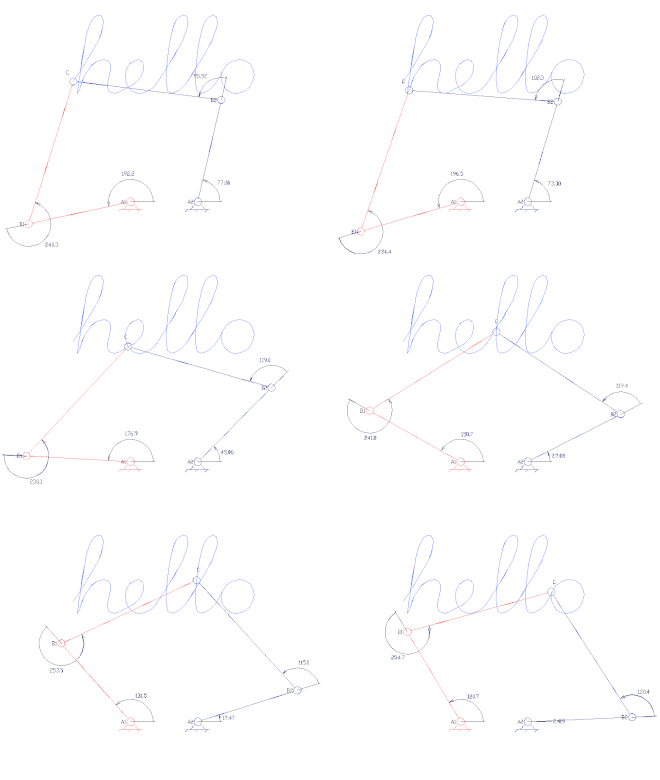


Deconstructing Motion
Kinematics is the foundational branch of classical mechanics dedicated to the geometrical description of motion. It abstracts away the 'why' – the forces and torques – to focus solely on the 'how.' This involves defining an object's position, velocity, and acceleration over time. Scientists utilize various coordinate systems, from the familiar Cartesian (rectangular) to curvilinear systems like polar coordinates, to represent these quantities.
The choice of reference frame is critical; motion is always described relative to another object or system, which itself might be in motion. This relativistic perspective is essential for accurately modeling complex scenarios, including rotating reference frames, which are common in analyzing machinery and celestial bodies. Kinematics provides the essential language and mathematical tools to quantify and predict the trajectory of any moving physical object.
Evolution of Understanding Motion
The intellectual journey of kinematics spans millennia, evolving from philosophical musings to rigorous mathematical formalisms. Early observations by figures like Aristotle and Archimedes touched upon motion, but it was the scientific revolution that truly birthed kinematics as a distinct field. Galileo Galilei's systematic experiments with inclined planes and falling bodies led to the formulation of kinematic equations describing uniform acceleration. Isaac Newton, in his Principia Mathematica, built upon this kinematic foundation, introducing his laws of motion and universal gravitation, which explained the forces causing motion.
The subsequent development of calculus by Newton and Leibniz provided the powerful mathematical machinery necessary for describing continuous change, enabling a far more precise and comprehensive kinematic analysis that underpins much of modern physics and engineering.
The Indispensable Role of Kinematics in Modern Innovation
The significance of kinematics extends far beyond theoretical physics; it is an indispensable tool driving innovation across numerous scientific and technological domains. In aerospace engineering, kinematic models are vital for designing aircraft and spacecraft, predicting flight paths, and ensuring stability. Robotics relies heavily on kinematics to control the precise movements of robotic arms, mobile platforms, and humanoid robots, enabling tasks from intricate surgery to autonomous navigation.
The entertainment industry uses kinematics extensively in computer graphics and animation to create lifelike character movements and dynamic virtual environments. Furthermore, in biomechanics, kinematics helps analyze human and animal locomotion, aiding in the development of prosthetics and understanding athletic performance. Essentially, any field that involves designing, analyzing, or predicting the movement of physical systems owes a fundamental debt to kinematics.
Mechanisms, Constraints, and the Geometry of Movement
A significant aspect of kinematics involves the study of constrained motion, particularly in mechanical systems. Constraints are limitations imposed on an object's or system's degrees of freedom, dictating the specific ways it can move. Examples include the fixed pivot of a pendulum, the linkage of gears in a clock, or the rolling motion of a wheel without slipping.
Analyzing these constraints is crucial for understanding the behavior of complex machinery, from simple levers to sophisticated robotic manipulators. Kinematic synthesis, a subfield, focuses on designing mechanisms that achieve a desired motion, effectively working backward from the required movement to the physical structure that will produce it. This interplay between describing motion and designing systems to achieve it highlights the practical power of kinematic principles.
Go deeper
Frequently Asked Questions
What is kinematics?+
Why do scientists use different coordinate systems in kinematics?+
How does kinematics help in building robots?+
Where is kinematics used in space travel?+
What are constraints in kinematics?+
Based on content from Wikipedia · Licensed under CC BY-SA 4.0