

Kincaid Mounds State Historic Site
Images

Kincaid Site mounds HRoe 07




Architectural and Societal Complexity at Kincaid
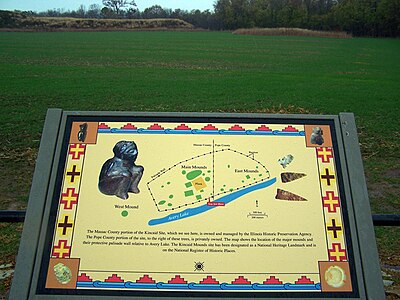
Kincaid Mounds State Historic Site, situated strategically at the confluence of the Ohio River in southern Illinois, stands as a significant testament to the Mississippian culture's societal organization and architectural prowess. Flourishing between approximately 1050 and 1400 CE, the site is characterized by its impressive array of at least 11 substructure platform mounds, placing it among the most substantial mound centers of its era.
These mounds, meticulously constructed from earth, served as elevated foundations for important structures, likely including elite residences, ceremonial buildings, and possibly temples, indicating a hierarchical social structure. The presence of 8 additional monuments further suggests a complex landscape designed for ritual, governance, and community gathering. Kincaid's geographical position along the Ohio River, a vital artery for transportation and trade, facilitated its role as a regional hub.
Its proximity to the paramount center of Cahokia, approximately 140 miles distant, highlights its integration into a broader Mississippian political and economic network. The site also bears evidence of earlier occupation by indigenous peoples of the Late Woodland period, underscoring the long-term significance of this location for human settlement.
The Mississippian Economy and Kincaid's Role
The Mississippian culture, to which the builders of Kincaid Mounds belonged, was characterized by intensive maize agriculture, which supported larger populations and more complex social structures than previous cultures. Kincaid Mounds, as a major settlement, would have been a focal point for agricultural production, resource management, and the distribution of goods. Its location on the Ohio River made it an ideal nexus for trade, connecting inland communities with those along the river and potentially further afield.
Artifacts recovered from Kincaid suggest participation in extensive exchange networks, with materials and finished goods traveling considerable distances. This economic activity likely fueled the social stratification evident in the mound construction and the presence of distinct residential areas. The site's importance as a prehistoric trading center, recognized by its designation as a National Historic Landmark, underscores its crucial role in the economic and social landscape of the Mississippian world.
Understanding Kincaid's function within this network provides critical insights into the dynamics of pre-Columbian societies in eastern North America.
Kincaid's Enduring Legacy in Archaeology
Beyond its intrinsic historical value, Kincaid Mounds has been profoundly influential in the development of modern archaeological science. The site has been the subject of significant research and excavation, contributing foundational knowledge to the study of the Mississippian culture. Early archaeological investigations at Kincaid, and subsequent more systematic studies, helped refine excavation techniques, artifact analysis, and interpretive frameworks used by archaeologists.
The meticulous documentation of stratigraphy and artifact distribution at Kincaid has provided case studies for understanding mound construction sequences and settlement patterns. The site's designation as a National Historic Landmark in 1964 was not only an acknowledgment of its cultural significance but also a commitment to its preservation for ongoing research and public education. Kincaid Mounds continues to be a vital resource for archaeologists seeking to understand the complexities of pre-Columbian societies, offering a tangible link to a sophisticated past and serving as a benchmark for archaeological practice.
From Ancient Settlement to Modern Preservation
The journey of Kincaid Mounds from a thriving Mississippian center to a protected historic site is a narrative of discovery, study, and preservation. While the exact circumstances of its abandonment remain subjects of ongoing research, the site's rich archaeological record offers clues to its past inhabitants' lives. The recognition of Kincaid's importance escalated over time, culminating in its declaration as a National Historic Landmark.
This designation signifies its national importance and mandates its protection from destruction or inappropriate alteration. Today, Kincaid Mounds State Historic Site serves as an invaluable educational resource, allowing visitors to connect with the history of Native American peoples and understand the scientific methods used to uncover that past. The ongoing efforts to preserve and interpret the site ensure that its stories and lessons are available for future generations, contributing to a broader understanding of human history and cultural heritage in North America.
See also
Based on content from Wikipedia · Licensed under CC BY-SA 4.0