

Karl Liebknecht
Images

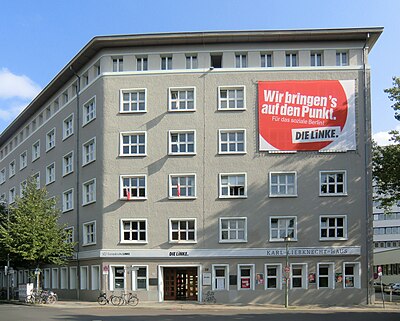
Karl Liebknecht-Haus Hohenstein-Ernstthal



Intellectual Roots and Early Political Activism
Karl Liebknecht emerged from a politically charged environment, being the son of Wilhelm Liebknecht, a co-founder of the Social Democratic Party of Germany (SPD). This upbringing instilled in him a deep understanding of socialist theory and practice. After studying law and political economy, Liebknecht became a prominent voice within the SPD's radical wing.
His early activism focused on challenging militarism and advocating for international solidarity among the working class. His intellectual rigor and passionate oratory quickly made him a significant figure. In 1907, his anti-militarist stance led to a year-long imprisonment for writing a pamphlet that criticized the military's influence, demonstrating his early commitment to challenging state power.
His election to the Reichstag in 1912 provided him with a national platform to articulate his increasingly radical views.
The Schism of World War I and the Birth of the Spartacus League
The outbreak of World War I in 1914 marked a critical turning point for both Germany and the SPD, and profoundly impacted Liebknecht's political trajectory. While the majority of the SPD leadership supported the war effort, voting for war credits in the Reichstag, Liebknecht vehemently opposed this 'Burgfrieden' (civil peace) policy. He viewed the war as an imperialist conflict that pitted the proletariat of different nations against each other for the benefit of the ruling class.
This fundamental disagreement led him, alongside Rosa Luxemburg and others, to form the Spartacus League (Spartakusbund) in 1914-1915. The League became the nucleus of revolutionary opposition within Germany, advocating for an end to the war and a socialist revolution. Liebknecht's continued defiance resulted in his expulsion from the SPD in 1916 and further imprisonment for leading anti-war demonstrations.
The Spartacus League's growing influence led to its integration into the Independent Social Democratic Party (USPD) in 1917, though its revolutionary aims often clashed with the USPD's more moderate stance.
The November Revolution and the Proclamation of a Republic
The collapse of the German Empire in November 1918, following its defeat in World War I, created a revolutionary vacuum that Liebknecht sought to fill. Released from prison shortly before the revolution, he immediately plunged into the political turmoil. On November 9, 1918, the same day Kaiser Wilhelm II abdicated, Liebknecht famously proclaimed Germany a 'Free Socialist Republic' from the balcony of the Berlin Palace.
This act was a direct challenge to the provisional government led by the SPD's Friedrich Ebert, which aimed for a parliamentary republic. Liebknecht's vision was more radical: a soviet republic where power would reside in councils of workers and soldiers. However, his attempt to establish this directly was met with resistance, and the Reich Congress of Workers' and Soldiers' Councils ultimately rejected the soviet model in favor of a more traditional parliamentary democracy, albeit one with strong social welfare provisions.
Founding the KPD and the Tragic Spartacist Uprising
Following the rejection of the soviet model, Liebknecht, Luxemburg, and their allies decided to forge a distinct revolutionary path. In December 1918, they formally founded the Communist Party of Germany (KPD), explicitly breaking from the SPD and USPD. The KPD aimed to establish a communist state through revolutionary means.
This led to the Spartacist uprising in January 1919, a desperate attempt by the KPD and other radical groups to seize power in Berlin. The uprising was poorly organized and faced overwhelming opposition from the Freikorps, paramilitary units composed of demobilized soldiers, who were actively supported by the SPD government. The Freikorps brutally suppressed the revolt.
In the aftermath, Karl Liebknecht and Rosa Luxemburg were captured, brutally interrogated, and summarily executed by Freikorps soldiers on January 15, 1919. Their deaths cemented their status as martyrs for the communist cause, profoundly influencing the subsequent trajectory of German and international communism, and leaving a legacy that continues to be a subject of historical debate and political commemoration.
See also
Frequently Asked Questions
Who was Karl Liebknecht?+
Why did Karl Liebknecht go to prison?+
What did Karl Liebknecht do during World War I?+
What was the Spartacus League?+
What happened after Karl Liebknecht proclaimed the Free Socialist Republic?+
Based on content from Wikipedia · Licensed under CC BY-SA 4.0