

Juliet (moon)
Images

Juliet (moon)


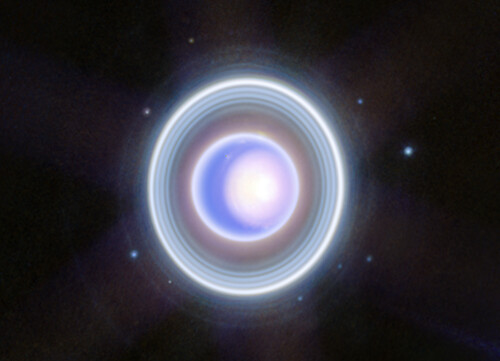


Characterizing an Inner Uranian Moon
Juliet is classified as one of Uranus's inner moons, a group characterized by their relatively small size, irregular shapes, and close proximity to the planet. With an estimated diameter of approximately 100 kilometers (60 miles), Juliet is considerably smaller than the major Uranian moons like Titania or Oberon. Its irregular, likely non-spherical shape suggests it has not undergone significant differentiation or hydrostatic equilibrium, common for smaller celestial bodies.
The surface composition is presumed to be a mixture of rock and ice, typical for moons in the outer solar system, though specific spectral analysis is limited due to its distance and size. Its low albedo indicates a dark surface, possibly due to radiation processing or the presence of carbonaceous material. Juliet's existence within the Uranian system provides a data point for understanding the distribution and characteristics of smaller satellites that populate the inner regions of planetary magnetospheres.
Orbital Dynamics and the Swift Dance of Juliet
Juliet completes a full orbit around Uranus in a remarkably short period of about 15 Earth hours. This rapid orbital period is a direct consequence of its close proximity to Uranus, orbiting at a mean distance of approximately 64,000 kilometers. For comparison, Earth's Moon orbits at an average distance of 384,400 kilometers and takes about 27.3 days.
Juliet's orbit is also relatively circular and lies close to Uranus's equatorial plane, though it is slightly inclined. The gravitational influence of Uranus is paramount in maintaining Juliet's orbit, and its speed is a critical factor in its stability against tidal forces and potential collisions with other inner moons. The rapid day-night cycle experienced by Juliet, dictated by its swift orbit, would create extreme temperature fluctuations if it possessed any significant atmosphere, which it does not.
Discovery and the Voyager 2 Legacy
The discovery of Juliet is intrinsically linked to the pioneering exploration of the outer solar system by the Voyager 2 spacecraft. Prior to Voyager 2's flyby in January 1986, only five major moons of Uranus were known. Voyager 2's advanced imaging system, however, was able to detect numerous smaller satellites in orbit around the planet.
Juliet was among the eleven moons discovered by Voyager 2, identified from images taken during the spacecraft's transit through the Uranian system. This discovery significantly expanded the known Uranian satellite population and provided crucial data for understanding the planet's complex ring and moon system. The identification of these smaller moons challenged existing theories about satellite formation and suggested a more dynamic history for Uranus's entourage than previously assumed.
Implications for Uranian System Formation and Evolution
Juliet, along with other inner Uranian moons like Cordelia and Ophelia, plays a role in the dynamics of Uranus's ring system. These moons are thought to be shepherd moons, helping to confine the particles within certain rings. The existence and characteristics of Juliet suggest that the inner Uranian moons may have formed from the disruption of a larger primordial moon or were captured objects that subsequently settled into stable orbits.
Alternatively, they could be remnants from the original accretion disk that formed Uranus. Studying Juliet's orbit and its potential interactions with other moons and rings helps scientists refine models of planetary system formation, particularly how smaller bodies coalesce and maintain their orbits within the gravitational dominance of a giant planet. Its irregular shape and small size are key indicators for understanding the processes of accretion and tidal forces in the early solar system.
Juliet's Place in the Cosmic Neighborhood
While Juliet may not possess the dramatic geological features of larger moons like Europa or Titan, its scientific value is substantial. It serves as a crucial piece of evidence in the ongoing effort to understand the diversity of moons throughout our solar system and beyond. Its discovery by Voyager 2 underscores the importance of dedicated space missions for expanding our cosmic horizons.
As astronomers continue to discover exoplanets and their potential moons, studying objects like Juliet provides a terrestrial analogue for understanding the formation and evolution of these distant worlds. Juliet is a reminder that even the smallest celestial bodies can hold significant clues about the universe's grandest processes.
See also
Frequently Asked Questions
What is Juliet?+
How fast does Juliet orbit Uranus?+
Who discovered Juliet and when?+
Does Juliet have an atmosphere?+
What role does Juliet play in Uranus's rings?+
Based on content from Wikipedia · Licensed under CC BY-SA 4.0