

Juana Inés de la Cruz
Images

Retrato de sor Juana Inés de la Cruz, Convento de Santa Paula (Sevilla)



A Prodigy's Path to the Cloister
Born Juana Inés de Asbaje y Ramírez de Santillana in 1648, Sor Juana Inés de la Cruz emerged as an extraordinary intellectual force in colonial New Spain. Her precocious talent was evident from childhood; she was reading by age three and composing poetry by her early teens. Driven by an insatiable thirst for knowledge, she entered the convent of the Hieronymite Order.
This decision, while seemingly conventional for a woman of her era seeking intellectual pursuits, provided her with the unique environment of a vast library and the relative freedom from domestic duties to dedicate herself to writing, philosophy, and scientific study. Her intellectual prowess quickly gained recognition, earning her the admiration of viceregal courts and the moniker 'The Tenth Muse' from her contemporaries, a testament to her literary genius that rivaled the greatest minds of the Spanish Golden Age.
Literary Output and Intellectual Defense
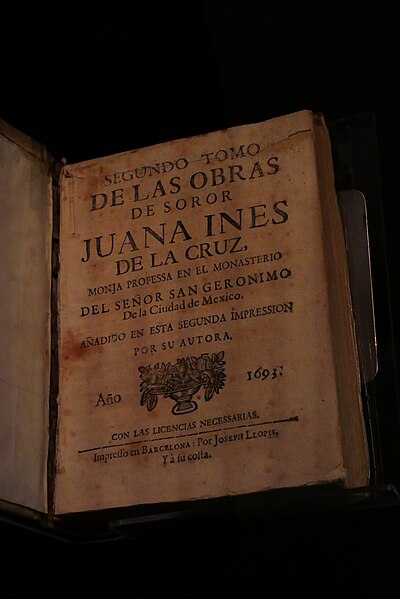
Sor Juana's literary output was remarkably diverse, encompassing poetry, plays, philosophical treatises, and scholarly essays. Her poetry explored themes of love, disillusionment, and the complexities of human emotion with sophisticated wit and lyrical beauty. Her dramatic works, such as 'Los empeños de una casa' (The House of Affairs), offered sharp social commentary.
However, her most significant intellectual contribution, and the one that cemented her controversial status, was her 'Respuesta a Sor Filotea de la Cruz' (Response to Sor Filotea de la Cruz). This lengthy letter, written in defense of her right to pursue secular knowledge and education, is a powerful feminist manifesto. In it, she meticulously argues for women's intellectual capabilities and their right to learn, directly challenging the patriarchal structures and prevailing misogyny of the 17th century.
This work alone positions her as a pioneering figure in the history of feminist thought.
Navigating Controversy and Church Scrutiny
Sor Juana's intellectual independence and outspokenness inevitably led to conflict with ecclesiastical authorities. Her extensive library and her engagement with secular learning were viewed with suspicion by some within the Church, who believed such pursuits were inappropriate for a nun. The 'Response' itself was a direct response to a bishop who had published a critique of her intellectual activities under a pseudonym.
While she received support from some influential figures, like the Vicereine Countess of Paredes, the pressure mounted. Ultimately, under duress, Sor Juana renounced her secular studies in 1694, dedicating her remaining years to religious devotion. This episode highlights the precarious position of intellectual women in the Baroque era and the constant tension between individual pursuit of knowledge and institutional control.
A Multifaceted Legacy
The interpretation and significance of Sor Juana's life and work have evolved dramatically since her death in 1695. In the 19th century, she was embraced as a symbol of Mexican national identity, a brilliant mind born from the soil of New Spain. Later, feminist scholars and activists rediscovered her as a proto-feminist icon, celebrating her defiance and her eloquent defense of women's intellectual rights.
Her work continues to be analyzed through lenses of gender studies, postcolonial theory, and literary criticism, revealing new layers of meaning. She remains a potent symbol for freedom of speech, intellectual liberation, and the enduring power of the written word, making her a figure of enduring debate and profound inspiration across diverse communities and academic disciplines.
See also
Frequently Asked Questions
Who was Sor Juana Inés de la Cruz?+
Why did she choose to live in a convent?+
What is the "Respuesta a Sor Filotea de la Cruz"?+
How did her writing help girls and women?+
What happened to her after she wrote her letter?+
Based on content from Wikipedia · Licensed under CC BY-SA 4.0