

Joachim von Ribbentrop
Images

Coat of Arms of Joachim von Ribbentrop (Order of Isabella the Catholic)

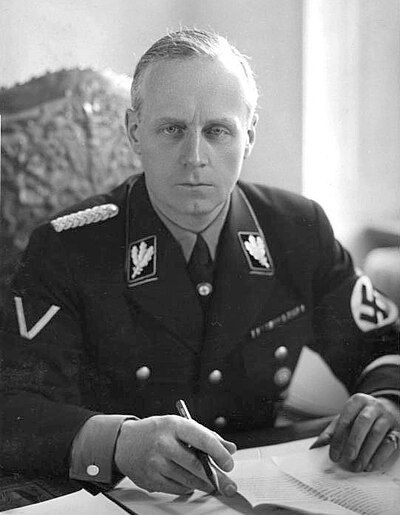


The Unlikely Ascent
Joachim von Ribbentrop's path to becoming Nazi Germany's Minister of Foreign Affairs was unconventional. Initially a successful businessman, particularly in the champagne and wine import industry, his extensive travels and cosmopolitan demeanor set him apart from many of the more provincial figures within the burgeoning Nazi Party. This worldly experience made him an attractive asset to Adolf Hitler, who sought advisors with a grasp of international affairs.
Ribbentrop's early support for Hitler, including hosting pivotal meetings at his estate, Schloss Fuschl, in January 1933 that facilitated Hitler's appointment as Chancellor, cemented his position as a trusted confidant. Despite internal party skepticism regarding his intellectual depth and perceived superficiality, Hitler valued Ribbentrop's loyalty and his ability to project an image of diplomatic sophistication. His appointment as Ambassador to the Court of St.
James's in 1936 provided him with direct experience in Western diplomacy, a role he used to gauge British willingness to appease Germany, before his ultimate elevation to Foreign Minister in February 1938. This trajectory highlights how personal connections and perceived utility could override traditional qualifications within the Nazi hierarchy.
The Diplomatic Architect of Aggression
Ribbentrop's tenure as Foreign Minister was defined by his instrumental role in forging alliances and agreements that paved the way for German aggression. He was a key architect of the Pact of Steel, signed in May 1939, which formalized the military and political alliance between Germany and Italy, creating a powerful Axis bloc. Even more consequential was the Molotov-Ribbentrop Pact, the Nazi-Soviet non-aggression treaty signed in August 1939.
This pact, which included secret protocols dividing Eastern Europe into spheres of influence, was a masterstroke of realpolitik that neutralized the Soviet threat, allowing Germany to invade Poland without immediate fear of a two-front war. Ribbentrop's advocacy for this pact, despite the ideological chasm between Nazism and Communism, demonstrated his pragmatic, albeit morally bankrupt, approach to foreign policy.
He also played a role in encouraging Japan to attack the United States, a strategic move aimed at weakening Allied resolve and resources, particularly after the implementation of American aid to Britain. His efforts were geared towards isolating and defeating Germany's adversaries through calculated diplomatic maneuvering and strategic alliances.
From Influential Minister to War Criminal
While Ribbentrop was a central figure in Nazi Germany's foreign policy for much of the pre-war and early war period, his influence began to wane significantly from 1941 onwards. The invasion of the Soviet Union, a move he had initially opposed, marked a turning point, and the subsequent expansion of the war into a global conflict strained Germany's resources and diplomatic options. As the war turned against Germany, Ribbentrop's ability to shape events diminished, though he remained in his post.
Following Germany's unconditional surrender in May 1945, Ribbentrop was apprehended by British forces in June 1945. His subsequent trial at the Nuremberg International Military Tribunal was a landmark event in international law. He was indicted on four counts: conspiracy to commit crimes against peace, planning and waging aggressive war, war crimes, and crimes against humanity.
The prosecution presented extensive evidence of his direct involvement in the diplomatic machinations that led to the war and his complicity in the Holocaust. The tribunal found him guilty on all counts, recognizing his profound responsibility for initiating and prosecuting a devastating global conflict and enabling horrific atrocities. His conviction underscored the principle that high-ranking officials are accountable for their actions, even when acting under the orders of a dictator.
The Legacy of Guilt
Joachim von Ribbentrop's life concluded with his execution by hanging on October 16, 1946, at the Nuremberg Prison. He was the first of the major Nazi defendants to face this ultimate penalty, a stark testament to the severity of his crimes as judged by the international community. His death marked the end of his personal journey, but his actions continue to be studied as a critical case study in the dynamics of authoritarian regimes, the nature of diplomatic responsibility, and the catastrophic consequences of unchecked aggression.
Ribbentrop's role highlights the dangerous intersection of personal ambition, ideological fervor, and state power. His conviction and sentence at Nuremberg served as a powerful message that individuals, regardless of their position, cannot escape accountability for orchestrating wars of aggression and facilitating widespread human rights abuses. The historical analysis of his career continues to inform discussions on international relations, the ethics of diplomacy, and the enduring importance of preventing future atrocities through vigilance and adherence to international law.
See also
Frequently Asked Questions
Who was Joachim von Ribbentrop?+
How did he become the Foreign Minister?+
What was the Pact of Steel?+
What was the Molotov‑Ribbentrop Pact?+
What happened to Ribbentrop after the war?+
Based on content from Wikipedia · Licensed under CC BY-SA 4.0