

Janka hardness test
Images
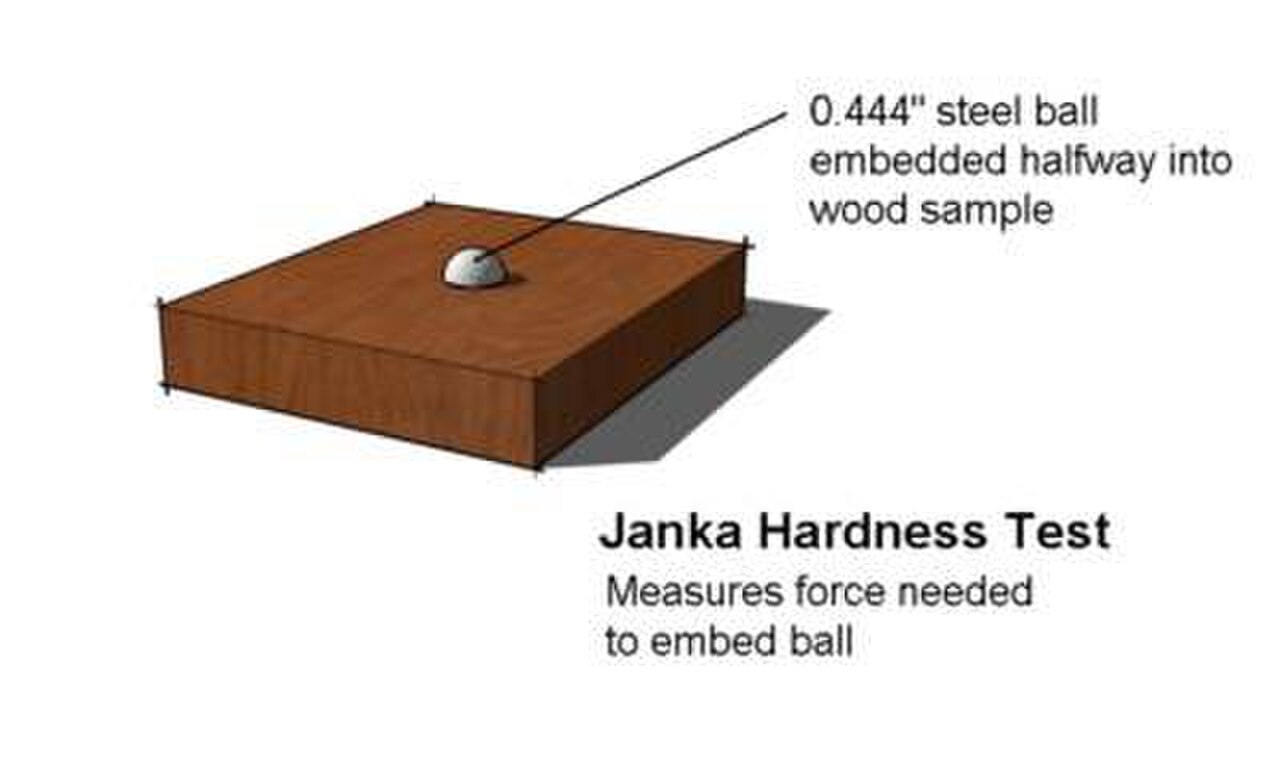
Janka hardness test
The Genesis and Mechanics of the Janka Hardness Test
The Janka hardness test, conceived by Austrian-American researcher Gabriel Janka, provides a quantitative measure of a wood species' resistance to permanent indentation and surface wear. The core principle involves measuring the static force required to embed a 11.28-millimeter-diameter steel ball precisely halfway into a wood specimen. This specific diameter is not arbitrary; it's chosen to yield an indentation area of 100 square millimeters, simplifying the interpretation of results.
The test is performed under controlled conditions, typically on wood samples conditioned to a standard moisture content of 12% and free from defects like knots. The force is applied perpendicular to the wood grain, simulating real-world stress. The results are universally recognized as a measure of force, though the units can vary significantly by region, leading to potential confusion if not clearly specified.
Historical Context and Standardization of Wood Hardness Measurement
Gabriel Janka's work in the late 19th and early 20th centuries aimed to bring scientific rigor to the selection of wood. Before standardized tests like the Janka, choosing wood for specific applications, particularly flooring, relied heavily on anecdotal evidence and tradition. The development of the Janka test provided a consistent metric, allowing for objective comparisons between different wood species.
Over time, the test has been refined and standardized by organizations like ASTM International, with methods such as ASTM D1037 for flooring samples and ASTM D143 for lumber. These standards ensure reproducibility and comparability of results across different laboratories and geographical locations, making the Janka rating a globally understood benchmark for wood hardness.
The Significance of Janka Ratings in Material Selection
The primary significance of the Janka hardness test lies in its application to material selection, most notably for hardwood flooring. A higher Janka rating indicates greater resistance to denting and wear, making the wood more durable and suitable for high-traffic areas. For instance, woods like hickory or Brazilian cherry, with very high Janka ratings, are exceptionally resistant to damage, whereas softer woods like pine or fir have much lower ratings and are more prone to wear.
This information is invaluable for consumers, architects, and designers, enabling them to make informed choices that balance aesthetic preferences with long-term performance and durability, ultimately influencing the lifespan and maintenance requirements of wooden installations.
Variations in Testing and Interpreting Janka Results
While the core principle of the Janka test remains consistent, variations exist in how it's applied and interpreted. Testing can be performed on the 'side hardness' (perpendicular to the grain on a plank's surface) or 'end hardness' (on the cut surface of a stump). Side hardness is further divided into radial and tangential hardness, though these distinctions are often minor.
A critical point of confusion arises from the reporting of results. While the measure is always a force, units vary: pounds-force (lbf) in the United States, kilograms-force (kgf) in Sweden, and newtons (N) or kilonewtons (kN) in Australia. Sometimes, results are stated without units (e.g., '660 Janka'), which can be misleading.
It's essential to understand that Janka ratings are averages, and actual performance can be influenced by factors like core materials in engineered wood, grain patterns, and moisture content.
Beyond Flooring
While most commonly associated with flooring, the Janka hardness test has broader implications for wood selection in various applications, including furniture manufacturing, tool handles, and even musical instruments where density and stability are key. Understanding Janka hardness also connects to broader concepts in materials science, such as Mohs hardness scale for minerals or Rockwell hardness for metals, all of which aim to quantify a material's resistance to deformation. The test highlights the anisotropic nature of wood, meaning its properties vary depending on the direction of measurement relative to the grain.
Furthermore, the Janka test serves as a foundational metric that informs other wood properties, such as its density and potential for use in structural applications where resistance to impact and compression is vital.
See also
Frequently Asked Questions
What is the Janka hardness test?+
How do scientists measure how hard wood is in the Janka test?+
Why do they use a steel ball that is 11.28 mm wide in the test?+
What does a high Janka rating mean for wood used in floors?+
How do people make sure the Janka test gives the same results everywhere?+
Based on content from Wikipedia · Licensed under CC BY-SA 4.0