

James Longstreet
Images

General James Longstreet


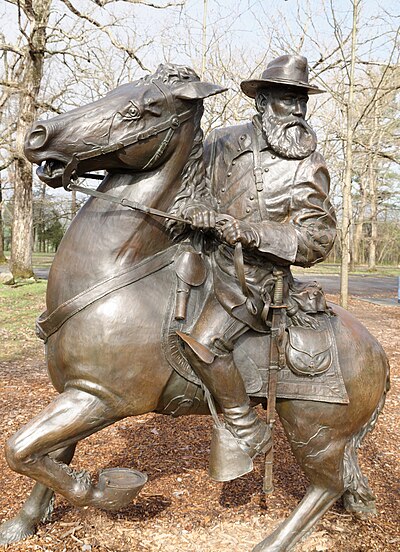


Foundations of Command
James Longstreet's military career was forged in the crucible of American expansion and conflict. Graduating from West Point in 1842, he served with distinction in the U.S. Army, gaining invaluable combat experience during the Mexican-American War. His wounding at the Battle of Chapultepec underscored the harsh realities of warfare, yet also marked a personal milestone as he married Louise Garland during his recovery.
The intervening decade saw him stationed on the challenging frontier of the American Southwest, developing the resilience and command presence that would define his later career. When the secession crisis erupted in 1861, Longstreet, a slaveholder from South Carolina, felt compelled to resign his U.S. Army commission.
He believed his loyalty lay with his home state, a decision that placed him on a collision course with his former comrades. His early contributions to the Confederacy, including a victory at Blackburn's Ford and a role in the First Battle of Bull Run, quickly established him as a significant military figure.
Eastern Theater Dominance
As a principal subordinate to General Robert E. Lee in the Army of Northern Virginia, James Longstreet earned the moniker 'Old War Horse' for his steadfastness and tactical skill. Lee relied heavily on Longstreet's corps, particularly in the crucial Eastern Theater.
Longstreet's leadership was instrumental in many Confederate victories, including the Seven Days Battles, where his corps helped defend Richmond, and the Second Battle of Bull Run, where his aggressive counterattack shattered Union lines. His troops were renowned for their defensive tenacity at Antietam and Fredericksburg, holding firm against overwhelming Union assaults. While his performance at Seven Pines was hampered by a navigational error, his overall contribution to Lee's successes was immense.
He was absent from the pivotal Battle of Chancellorsville, having been detached for the comparatively minor Siege of Suffolk, a fact that highlights the strategic demands placed upon Confederate leadership.
Gettysburg's Shadow and Western Theater Struggles
The Battle of Gettysburg in July 1863 remains the most controversial chapter of Longstreet's military career. He openly disagreed with Lee's aggressive tactics, advocating for a more defensive strategy. Despite his reservations, he reluctantly executed Lee's orders, supervising several costly and ultimately unsuccessful assaults on Union positions, most notably Pickett's Charge.
This experience deeply affected Longstreet and fueled later criticism. Following Gettysburg, he requested a transfer to the Western Theater under General Braxton Bragg. There, his troops achieved a significant victory at Chickamauga with a powerful assault, but his subsequent command during the Knoxville campaign resulted in a Confederate defeat.
His tenure in the West was further marred by acrimonious disputes with fellow Confederate generals, highlighting command friction within the Confederate leadership.
Post-War Transformation and Enduring Controversy
Longstreet's post-war life was as complex as his wartime service. He embraced Reconstruction and supported the Republican Party, working for the U.S. government under President Ulysses S. Grant, his former Union adversary.
This alignment, coupled with his published criticisms of Lee's wartime decisions, alienated many former Confederates and fueled the 'Lost Cause' narrative, which often scapegoated Longstreet for the South's defeat. His participation in the Battle of Liberty Place in 1874, leading African-American militia against white supremacists, further solidified his controversial status. However, since the late 20th century, historical reassessment has begun to paint a more nuanced picture.
Many scholars now recognize Longstreet's exceptional tactical abilities and his strategic insights, acknowledging him as one of the Civil War's most gifted commanders, whose legacy continues to be debated and reinterpreted.
See also
Frequently Asked Questions
Who was James Longstreet?+
Why did he leave the U.S. Army?+
What battles did he fight in?+
What was his role at Gettysburg?+
What did he do after the war?+
Based on content from Wikipedia · Licensed under CC BY-SA 4.0