

Ice Tongue: The Frozen River's Reach!
Images
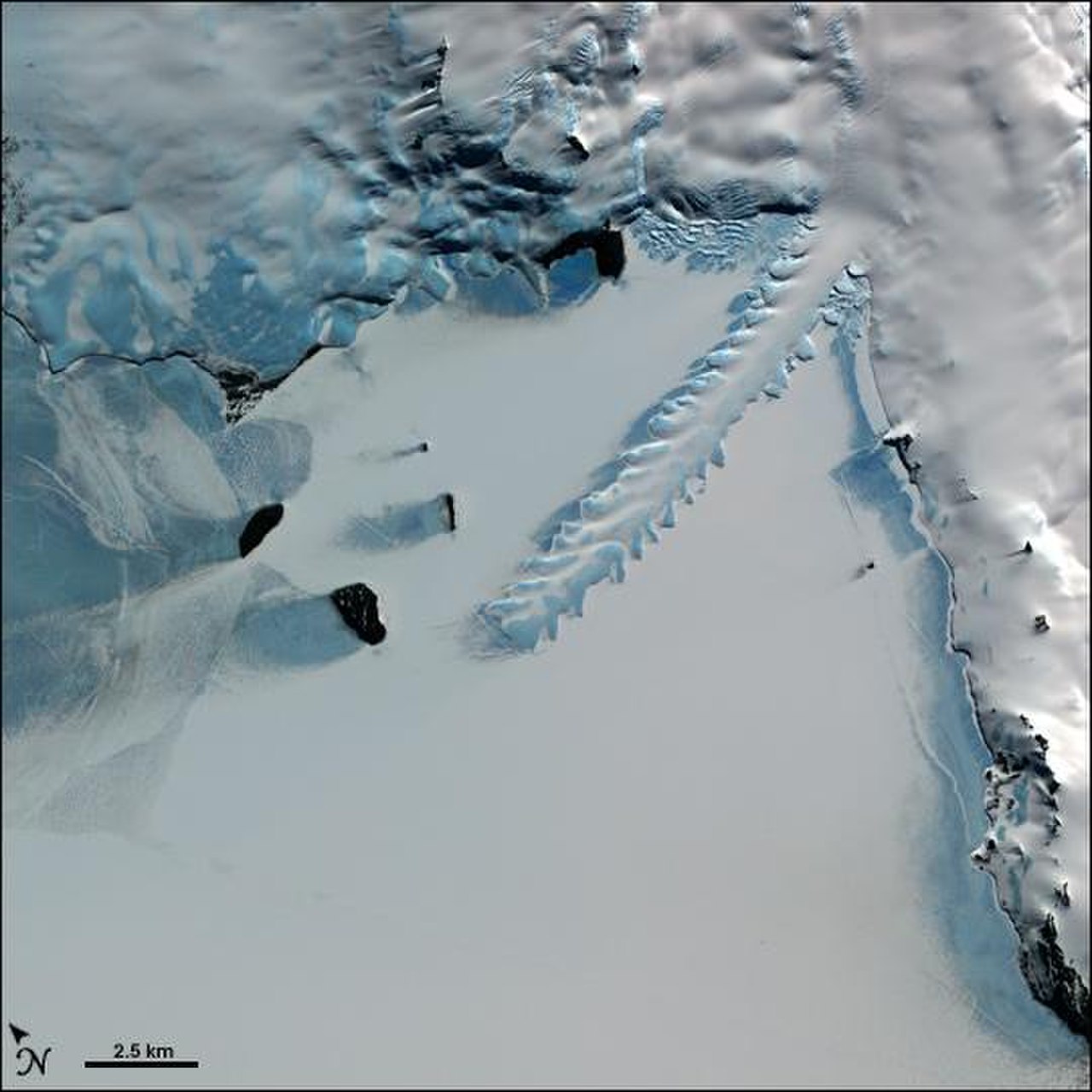
Ice tongue
The Dynamics of Glacial Outlets
Ice tongues represent the distal portions of larger ice masses, acting as conduits through which ice flows from accumulation zones to lower elevations or ice shelves. Their formation is intrinsically linked to the accumulation and compaction of snow over millennia, leading to the development of glacial ice. This ice then deforms under its own weight and flows downslope due to gravitational forces.
The specific morphology and behavior of an ice tongue are influenced by a complex interplay of factors, including the underlying topography, ice thickness, basal thermal regime (whether the ice is frozen to the bed or sliding), and the presence of meltwater. Different flow regimes, such as fast-flowing outlet glaciers or slower-moving ice streams, dictate the speed and character of ice tongue advance. Understanding these dynamics is critical for predicting ice loss from major ice sheets and its contribution to global sea-level rise.
Geomorphological Impact
The erosional and depositional power of ice tongues is immense, playing a significant role in shaping planetary landscapes over geological timescales. As they advance, they exert tremendous force on the bedrock, a process known as glacial abrasion. Rocks and debris embedded in the ice act as abrasive agents, grinding down the substrate and carving out distinctive landforms like U-shaped valleys, cirques, and fjords. This debris is then transported and deposited, forming features such as moraines, drumlins, and eskers.
In coastal regions, ice tongues that terminate in the ocean can contribute to iceberg calving, a major mechanism for ice mass loss and sediment dispersal into marine environments. The geological record preserved in these landforms provides invaluable insights into past glacial extents and climatic conditions.
Paleoclimatic Archives
Ice tongues and the glaciers they extend from serve as unparalleled natural archives of Earth's past climate. By extracting ice cores-long cylindrical samples drilled from deep within the ice-scientists can analyze trapped air bubbles, isotopic ratios, dust particles, and chemical signatures. These proxies offer a high-resolution record of atmospheric composition, temperature fluctuations, volcanic activity, and even biological productivity stretching back hundreds of thousands of years.
For instance, the ratio of different oxygen isotopes in the ice can reveal past temperatures, while trapped CO2 concentrations directly reflect atmospheric greenhouse gas levels. Studying these records allows researchers to understand natural climate variability, the drivers of past warming and cooling events, and to contextualize current anthropogenic climate change within a long-term perspective.
Modern Relevance
In the contemporary context, ice tongues are at the forefront of climate change research. Their behavior-specifically the rate at which they advance, retreat, and contribute to ice loss-is a key indicator of global warming. Accelerated melting and thinning of ice tongues, particularly those buttressing floating ice shelves, can lead to destabilization and increased discharge of ice into the ocean, directly impacting global sea levels. Satellite monitoring technologies, including radar and optical imagery, allow scientists to track changes in ice tongue velocity, surface elevation, and calving events with unprecedented accuracy.
This data is crucial for refining climate models, improving projections of future sea-level rise, and informing policy decisions aimed at mitigating the impacts of a warming planet. The health of ice tongues is, therefore, a vital barometer for the planet's climatic well-being.
See also
Based on content from Wikipedia · Licensed under CC BY-SA 4.0