

Ice Rink Adventures!
Images

Ice rink


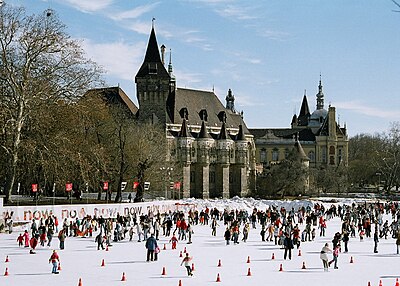


From Natural Ice to Engineered Surfaces
The concept of an ice rink evolved from the serendipitous use of naturally frozen bodies of water to highly engineered, artificial environments. Historically, ice skating and sports like curling were confined to winter months and the availability of frozen lakes and rivers. The burgeoning popularity of ice skating and the formalization of sports like ice hockey in the 19th century spurred innovation.
This era saw the deliberate construction of dedicated ice surfaces, initially often outdoors, to provide a more reliable and accessible venue. The term 'rink,' originating from a Scottish word for 'course,' initially described the playing area for curling. As ice hockey gained prominence, the term was adopted, signifying a dedicated space for ice-based team sports.
This transition marked a significant shift from recreational pastime to organized sport, necessitating controlled environments.
The Dichotomy of Ice Rink Technology
Contemporary ice rinks largely fall into two categories: natural and artificial. Natural ice rinks are dependent on ambient meteorological conditions, where sub-zero temperatures allow water to freeze and remain solid. These are often seasonal and found in regions with consistently cold winters.
In contrast, artificial ice rinks employ complex refrigeration technology to maintain a frozen surface regardless of external temperatures. This involves a network of pipes embedded in the rink's foundation, through which a refrigerant circulates. This coolant absorbs heat, chilling the concrete slab and subsequently freezing the water layers applied on top.
This technological advancement has democratized ice sports, enabling their practice and competition in diverse climates and year-round. Synthetic ice, made from specialized polymers, offers another alternative, providing a low-friction surface for practice without the need for refrigeration, though it differs in glide characteristics from real ice.
A Spectrum of Ice Sports and Their Demands
The versatility of the ice rink is evident in the wide array of sports it accommodates, each with distinct requirements for ice quality and dimensions. Ice hockey, a high-octane team sport, demands a hard, smooth surface for rapid puck movement and aggressive play. Figure skating, conversely, requires meticulous ice preparation for intricate jumps, spins, and edge work, often necessitating a slightly softer, more forgiving surface. Speed skating events, particularly long-track, utilize vast oval tracks where consistent ice conditions are paramount for achieving peak velocities.
Curling, a game of strategy and precision, requires a meticulously prepared surface, often with 'pebbled' ice (tiny water droplets frozen onto the surface) to control the stone's curl. Other sports like bandy, ringette, and broomball further illustrate the adaptability of the ice rink as a sporting venue, each contributing to its cultural and athletic significance.
The Engineering of Perpetual Winter
The operational heart of an artificial ice rink is its refrigeration system, a sophisticated piece of engineering designed to create and sustain sub-zero temperatures. Typically, a brine solution or a similar coolant is circulated through a labyrinth of pipes laid beneath the ice surface. This coolant, chilled by a large compressor unit, absorbs thermal energy from the concrete slab and the overlying ice.
The efficiency of this system is critical; fluctuations in temperature can compromise ice integrity, affecting athletic performance and safety. Modern systems often incorporate heat exchangers to recover energy, improving efficiency and reducing environmental impact. The process of resurfacing, commonly done with a Zamboni or similar ice-resurfacing machine, involves shaving off a thin layer of old ice and applying a fresh layer of hot water, which freezes smoothly, ensuring optimal conditions for subsequent use.
Socio-Economic and Cultural Significance of Ice Rinks
Beyond their function as sporting arenas, ice rinks serve as vital socio-cultural centers. They foster community engagement, providing spaces for recreation, fitness, and social interaction across age groups. For many communities, particularly in colder climates, ice rinks are focal points for winter activities, contributing to local economies through tourism, event hosting, and facility employment.
They are platforms for skill development, nurturing athletic talent from grassroots levels to elite competition. Furthermore, ice rinks can be catalysts for urban development and revitalization projects. The programming within these facilities, ranging from public skating sessions and youth hockey leagues to synchronized skating teams and professional ice shows, underscores their multifaceted role in contemporary society, promoting physical health and cultural enrichment.
See also
Frequently Asked Questions
What is an ice rink and how did it start?+
How do artificial ice rinks stay cold all year?+
Why do different sports need different ice surfaces?+
Can you play on ice in places that never get very cold?+
What is synthetic ice and how is it different from real ice?+
Based on content from Wikipedia · Licensed under CC BY-SA 4.0