

Hyperthermal event
Images
Hyperthermal event
Defining the Anomaly
Hyperthermal events represent a distinct category of paleoclimatic shifts characterized by rapid and substantial increases in global mean temperature, occurring over geologically short timescales, typically thousands to tens of thousands of years. Unlike gradual climate change driven by orbital cycles or slow tectonic processes, hyperthermals are marked by their abruptness, often leading to significant perturbations in Earth's carbon cycle and biosphere. Scientific understanding of these events is derived from proxy records, including stable isotopes in marine sediments and ice cores, organic biomarkers, and fossil assemblages, which collectively paint a picture of dramatic environmental upheaval.
These events serve as crucial case studies for understanding the sensitivity and potential tipping points of Earth's climate system, offering insights into how quickly and profoundly the planet can respond to external forcing.
Chronicles of Warming
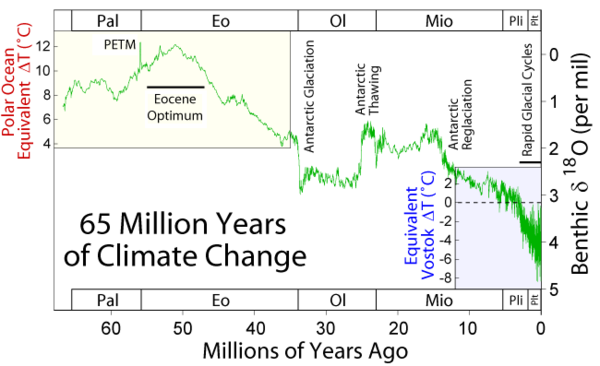
Earth's history is punctuated by several significant hyperthermal events. The most extensively studied is the Paleocene-Eocene Thermal Maximum (PETM), approximately 56 million years ago, which saw a global temperature rise of 5-8°C within a few thousand years. The primary trigger for the PETM is widely believed to be a massive injection of carbon into the atmosphere and ocean, likely from the dissociation of methane hydrates stored in ocean sediments or from extensive volcanism associated with the North Atlantic Igneous Province.
Other notable hyperthermals include the Eocene Climatic Optimum (ECO) and various events within the early Cenozoic. Investigating these events involves complex geochemical modeling and high-resolution stratigraphic analysis to pinpoint the timing, magnitude, and sources of carbon release, thereby refining our understanding of the feedback mechanisms that amplify initial warming.
Ecological Cataclysms
The rapid warming associated with hyperthermal events has consistently resulted in profound ecological consequences. During the PETM, for instance, there was a significant turnover in marine and terrestrial life. Many species, particularly those in the deep ocean, faced extinction due to ocean acidification and anoxia, conditions exacerbated by increased atmospheric CO2.
Terrestrial ecosystems also experienced shifts, with evidence of range expansions for thermophilic (heat-loving) species and potential extinctions of cold-adapted flora and fauna. These events underscore the vulnerability of biodiversity to rapid climate change and highlight how evolutionary pressures can lead to significant restructuring of ecosystems. Studying these past biodiversity crises provides a vital analog for assessing the potential long-term impacts of anthropogenic climate change on current species.
The Carbon Cycle Under Siege
The fundamental mechanism driving hyperthermal events is a rapid and substantial increase in atmospheric greenhouse gas concentrations, primarily carbon dioxide (CO2) and methane (CH4). These gases enhance the planet's natural greenhouse effect, trapping more solar radiation and leading to warming. The sources of these massive carbon releases are thought to be geological in nature, involving processes that can mobilize vast carbon reservoirs over relatively short periods.
Potential triggers include large-scale volcanic outgassing, the thermal decomposition of organic-rich sedimentary rocks, or the destabilization of methane hydrates-frozen methane deposits found on the seafloor. The subsequent warming can then trigger positive feedback loops, such as increased decomposition of organic matter and further methane release, amplifying the initial temperature rise and creating a self-sustaining warming trend until the excess carbon is sequestered back into geological reservoirs.
Lessons from the Past
Hyperthermal events offer critical insights into the potential trajectory and impacts of contemporary anthropogenic climate change. The speed at which these past events unfolded, driven by natural processes, serves as a stark reminder of Earth's capacity for rapid climatic shifts. By studying the causes and consequences of historical hyperthermals, scientists can refine climate models and improve predictions for future warming scenarios.
The observed ecological disruptions, such as mass extinctions and ecosystem reorganizations, provide a tangible preview of the challenges facing biodiversity today. Furthermore, understanding the carbon cycle dynamics during these events helps us quantify the sensitivity of Earth's systems to greenhouse gas forcing. Ultimately, hyperthermals underscore the urgency of mitigating current emissions, as they demonstrate that rapid, significant climate change can have devastating and long-lasting effects on the planet's habitability.
See also
Based on content from Wikipedia · Licensed under CC BY-SA 4.0