

Hyades: The Star Family Next Door!
Images

Hyades (star cluster)


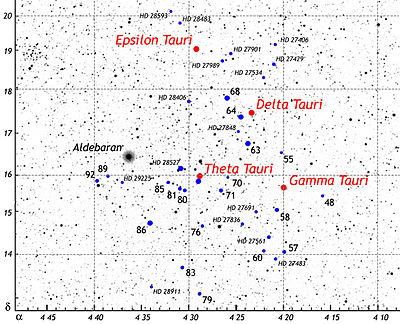


The Hyades
The Hyades star cluster represents a pivotal celestial object for astronomical research, primarily due to its proximity to Earth. Situated approximately 153 light-years away in the constellation Taurus, it is the nearest open cluster, making it an exceptionally valuable target for detailed study. Comprising over 100 confirmed members, and potentially many more faint ones, the Hyades are believed to have formed from the same giant molecular cloud roughly 625 million years ago.
This shared origin imbues the cluster with a relatively uniform age and chemical composition, providing astronomers with a consistent sample to investigate fundamental astrophysical processes. Its apparent shape, a prominent 'V', has been recognized since antiquity, though its true nature as a gravitationally bound group of stars was established much later through kinematic studies.
Kinematics and Membership
The identification of Hyades cluster members is a sophisticated process relying on precise measurements of stellar positions, velocities, and luminosities. While the visual 'V' shape is striking, the brightest star, Aldebaran, is a foreground contaminant, lying at a much closer distance of about 65 light-years. True members of the Hyades exhibit a common proper motion, meaning they are all moving across the sky in nearly the same direction and at the same speed.
This shared trajectory, coupled with spectroscopic analysis revealing similar chemical abundances and radial velocities, confirms their common origin. The cluster's velocity vector indicates it is moving towards the solar apex, a direction in space. Studying these kinematics allows astronomers to model the cluster's past and future trajectory within the Milky Way galaxy, offering insights into galactic structure and dynamics.
Stellar Evolution and the Hyades' Diverse Population
The Hyades cluster serves as an invaluable laboratory for studying stellar evolution. Its age of approximately 625 million years places its stars in a phase where their evolutionary paths are well-understood and observable. The cluster contains a diverse range of stellar types, including main-sequence stars, subgiants, and giants, as well as white dwarfs.
By examining the distribution of these stars on the Hertzsprung-Russell (H-R) diagram, astronomers can precisely determine the cluster's age and compare it with theoretical stellar evolution models. The Hyades' H-R diagram is particularly well-defined due to the cluster's relative closeness and the abundance of data available. Furthermore, the cluster hosts exoplanets, such as those orbiting the star Tau-42, providing opportunities to study planet formation and evolution within a cluster environment, which differs from the field star environment.
Significance in Calibration and Galactic Archaeology
The Hyades cluster plays a crucial role in calibrating fundamental astronomical quantities. Its distance, determined through various methods including parallax measurements and spectroscopic parallax, has historically been used to anchor the cosmic distance ladder. Accurate distance measurements to the Hyades allow for more precise calibration of other distance indicators.
Beyond its role in distance calibration, the Hyades are significant for galactic archaeology. As one of the oldest and closest known star clusters, it provides a window into the conditions of the Milky Way galaxy during its earlier epochs. Studying the chemical composition of Hyades stars can reveal clues about the composition of the interstellar medium from which they formed, contributing to our understanding of galactic chemical evolution.
The cluster's dynamic history and its interaction with the galactic environment also offer insights into the processes that shape stellar populations over billions of years.
See also
Frequently Asked Questions
What are the Hyades and why do they look like a 'V' in the sky?+
How far away are the Hyades from Earth?+
Why is the Hyades cluster special for scientists?+
Are there planets in the Hyades cluster?+
Who is Aldebaran and why is it not part of the Hyades?+
Based on content from Wikipedia · Licensed under CC BY-SA 4.0