

Human spaceflight programs
Images

KSC-20181019-PH_CDC01_0005




The Genesis of Human Spaceflight
The history of human spaceflight is inextricably linked to geopolitical competition, primarily the Cold War Space Race between the United States and the Soviet Union. From the late 1950s through the 1970s, government-funded programs, often with military origins or oversight, were the sole drivers of human space exploration. These initiatives, such as the Soviet Vostok and Soyuz programs and the US Mercury, Gemini, and Apollo programs, were monumental undertakings.
They required unprecedented technological innovation, vast financial investment, and immense human courage. The primary motivations were national prestige, scientific discovery, and the demonstration of technological superiority. The successes of these early programs, including the first human in orbit (Yuri Gagarin) and the first lunar landing (Apollo 11), not only expanded humanity's reach but also spurred advancements in fields ranging from computing to materials science, with applications that continue to benefit society today.
The establishment of space agencies like NASA and Roscosmos marked a new era of organized, large-scale scientific endeavor.
The Multifaceted Significance of Reaching Beyond Our Atmosphere
Human spaceflight programs serve a critical role that extends far beyond exploration for its own sake. Scientifically, space offers a unique laboratory. The microgravity environment allows for experiments in biology, physics, and materials science that are impossible on Earth, leading to advancements in medicine (e.g., understanding bone density loss) and the development of new materials.
From an Earth observation perspective, human spaceflight provides invaluable data for monitoring our planet's climate, weather patterns, and environmental changes, crucial for addressing global challenges. Furthermore, space programs foster international cooperation, as seen with the International Space Station (ISS), which brings nations together for common goals. They also inspire future generations of scientists and engineers, driving educational pursuits and technological innovation.
The pursuit of space travel pushes the boundaries of human ingenuity and our understanding of the cosmos, addressing fundamental questions about our place in the universe.
Defining the Frontier
Establishing a definitive boundary for space is a subject of ongoing discussion, with different organizations using varying criteria. The most widely recognized international standard, set by the Fédération Aéronautique Internationale (FAI), defines the boundary of space, known as the Kármán line, at an altitude of 100 kilometers (62 miles) above mean sea level. Crossing this line signifies entering outer space.
However, the United States employs a slightly different threshold for awarding astronaut status. For professional, military, and commercial astronauts, reaching an altitude of 80 kilometers (50 miles) is sufficient to earn the U.S. Astronaut Badge.
This distinction highlights the practical and operational definitions used within different contexts. While the FAI's 100 km mark is the benchmark for official spaceflight, the 80 km threshold acknowledges significant achievements in high-altitude flight that approach the edge of space, underscoring the continuous spectrum of atmospheric and near-space flight.
The Evolving Landscape
Until the dawn of the 21st century, human spaceflight was exclusively the domain of government agencies. This paradigm began to shift dramatically with the advent of commercial spaceflight. The successful launch of SpaceShipOne in 2004 by Scaled Composites marked a pivotal moment, demonstrating the viability of privately funded human space missions.
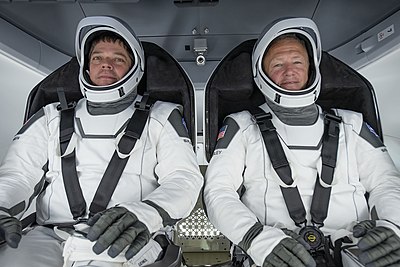
This paved the way for companies like SpaceX, which has not only achieved orbital flights with its Crew Dragon spacecraft but also developed reusable rocket technology, significantly reducing launch costs. Blue Origin is another key player, focusing on suborbital tourism and developing heavy-lift launch capabilities. This transition from government-led to a mixed ecosystem of government and commercial entities is revolutionizing access to space. It promises increased innovation, greater competition, and potentially more affordable opportunities for scientific research, resource utilization, and even space tourism, fundamentally altering the future trajectory of human exploration.
See also
Frequently Asked Questions
Who was the first human to orbit Earth?+
Why did the United States and the Soviet Union send people to space?+
How do space programs help us on Earth?+
What is the Kármán line?+
How do astronauts earn a badge in the United States?+
Based on content from Wikipedia · Licensed under CC BY-SA 4.0