

Hubert H. Humphrey Metrodome
Images

Twins Outfielders, Detroit Tigers 6, Minnesota Twins 4, Comerica Park, Detroit, Michigan




Genesis of a Modern Sports Arena
The Hubert H. Humphrey Metrodome, commonly known as 'The Dome,' was conceived as a modern replacement for aging sports facilities in Minneapolis, Minnesota. Opened in 1982, it was designed to consolidate the home venues for several major sports franchises: the NFL's Minnesota Vikings, Major League Baseball's Minnesota Twins, and the University of Minnesota's Golden Gophers football team.
This multi-purpose design aimed to provide a state-of-the-art experience for athletes and spectators alike, offering a consistent environment regardless of external weather conditions. The decision to build a domed stadium was a significant investment, reflecting a growing trend in sports architecture to create climate-controlled venues capable of hosting a wide array of events, from professional games to collegiate championships and even concerts.
Engineering the Air-Supported Enigma
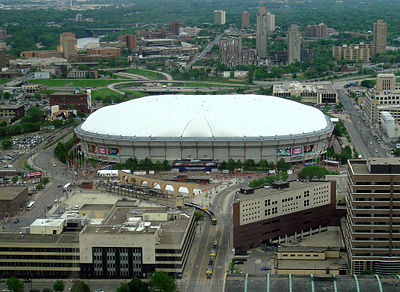
The Metrodome's most defining characteristic was its revolutionary air-supported roof. Constructed from a specialized fiberglass fabric, the roof was not held up by internal columns or trusses but by a constant differential in air pressure. Fans were pumped into the stadium, creating a higher pressure inside than outside, which effectively inflated and supported the massive dome structure.
This pioneering technology placed the Metrodome among the first of its kind, alongside facilities like the Pontiac Silverdome and the Carrier Dome. The design was so influential that it served as a direct inspiration for the Tokyo Dome in Japan, showcasing its global impact on stadium engineering and architectural innovation. The roof's unique nature also meant it was susceptible to deflation, a phenomenon that occurred famously during a blizzard in 1983.
A Crucible of Sporting History
Beyond its architectural significance, the Metrodome served as the stage for numerous iconic moments in sports history. It is uniquely distinguished as the only venue to have hosted the pinnacle events of four major American sports leagues: the NFL's Super Bowl (XXVI in 1992), Major League Baseball's World Series (1987 and 1991), the MLB All-Star Game (1985), and the NCAA Division I Men's Basketball Final Four (1992 and 2001).
The stadium witnessed thrilling victories, dramatic comebacks, and unforgettable performances that are etched into the annals of sports. Its capacity to host such diverse and high-stakes events underscored its importance as a premier sports destination in the United States.
The Dome's Demise and Enduring Legacy
After decades of service, the Metrodome's time came to an end as Minneapolis prepared for a new, modern stadium. Following the Minnesota Vikings' final home game on December 29, 2013, the stadium's iconic air-supported roof was deflated, marking the beginning of its deconstruction. Demolition commenced in January 2014, with the stadium being dismantled in sections to allow for the concurrent construction of U.S. Bank Stadium on an adjacent site.
While the physical structure is gone, the Metrodome's legacy persists. It is remembered not only for the countless games and events it hosted but also for its groundbreaking architectural design that influenced stadium construction worldwide and its role in shaping the sporting identity of Minneapolis for over thirty years.
See also
Frequently Asked Questions
What was the Hubert H. Humphrey Metrodome and when did it open?+
How did the Metrodome's roof stay up?+
What kinds of sports games were played at the Metrodome?+
Why did the Metrodome get demolished?+
Did the Metrodome influence other stadiums?+
Based on content from Wikipedia · Licensed under CC BY-SA 4.0