

Hindi Language
Images

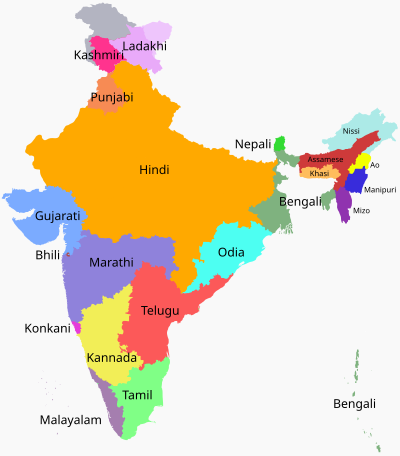
Fastest growing languages of India — Hindi (first), Kashmiri (second), Gujarati & Meitei alias Manipuri (third), Bengali (fourth) — based on 2011 census of India




The Genesis and Evolution of Modern Hindi
Modern Hindi, a prominent member of the Indo-Aryan language family, traces its lineage back to Sanskrit, the classical language of ancient India. Its development is a complex narrative of linguistic change and cultural interaction. Following the decline of Sanskrit's widespread use, Prakrit languages, the vernacular descendants of Sanskrit, became dominant.
Among these, Sauraseni Prakrit played a crucial role in the formation of early forms of Hindi. The medieval period saw significant influence from Persian and Arabic, particularly during the Delhi Sultanate and Mughal Empire. This contact led to the incorporation of a vast lexicon of Persian and Arabic words, especially in administrative, legal, and literary contexts.
The standardization of Hindi, often referred to as Khari Boli, gained momentum in the 19th century, with scholars and writers actively shaping its grammar and vocabulary to create a distinct literary and national language. This process involved codifying its script, Devanagari, and establishing a literary canon that distinguished it from its close linguistic relative, Urdu, which shares much of its core vocabulary and grammar but uses the Perso-Arabic script and has a stronger Persian and Arabic literary tradition.
Sociolinguistic Landscape and National Identity
Hindi occupies a central position in the sociolinguistic fabric of India, serving as one of the country's official languages alongside English. Its widespread use, particularly in the northern and central Hindi Belt, makes it a powerful symbol of national identity and a facilitator of inter-state communication. However, its dominance has also been a subject of debate and political sensitivity, with regional linguistic movements advocating for the recognition and promotion of other major Indian languages.
The language's reach is amplified by its pervasive presence in popular culture, most notably through Bollywood, which has disseminated Hindi globally. Furthermore, the digital revolution has seen an exponential growth in Hindi content online, making it a significant language in the global internet sphere. This multifaceted role highlights Hindi's dynamic interplay with social, political, and cultural forces within India and its growing influence internationally.
Phonological and Grammatical Distinctiveness
The phonology of Hindi is characterized by several distinctive features. It possesses a rich inventory of consonants, including a series of unaspirated, aspirated, and voiced stops, as well as retroflex consonants produced with the tongue curled back against the palate. The distinction between aspirated and unaspirated consonants, such as 'p' vs. 'ph' (as in 'pat' vs. 'phat'), is phonemic, meaning it can change the meaning of a word.
Grammatically, Hindi is an agglutinative language with an SOV (Subject-Object-Verb) word order, which is a significant departure from English's SVO structure. For instance, 'Ram ate the apple' translates to 'Ram seb khaya' (Ram apple ate). It employs postpositions instead of prepositions (e.g., 'ghar mein' meaning 'in the house').
Hindi also features a complex system of verb conjugations that agree in gender and number with the subject or object, and it utilizes ergativity in certain past tense constructions, where the subject of a transitive verb takes a special case marker ('ne').
Hindi's Global Footprint
Hindi's influence extends far beyond the Indian subcontinent, shaping global culture, commerce, and communication. The international success of Bollywood cinema has made Hindi a recognizable language worldwide, fostering a global audience for Indian films, music, and fashion. This cultural export has, in turn, spurred interest in learning the language itself.
In the economic sphere, Hindi is increasingly important as India's economy grows, facilitating business interactions with Indian companies and markets. For the vast Indian diaspora, Hindi serves as a crucial link to their heritage, maintaining cultural connections across generations and continents. Online, Hindi is a major language, with a substantial presence on social media platforms, search engines, and digital content sites, underscoring its relevance in the digital age.
The growing number of Hindi language programs in universities and cultural centers abroad further attests to its expanding global footprint and its role as a bridge between cultures.
Key Linguistic Connections and Divergences
Hindi shares a deep linguistic kinship with Urdu, often described as two registers of the same language, Hindustani. They are mutually intelligible in spoken form and share a common grammatical structure and core vocabulary derived from Sanskrit and Prakrit. However, they diverge significantly in their script (Devanagari for Hindi, Perso-Arabic for Urdu) and in their literary and technical vocabulary, with Urdu drawing more heavily from Persian and Arabic.
Understanding Hindi also provides insights into other Indo-Aryan languages like Punjabi, Bengali, and Marathi, revealing shared roots and evolutionary pathways. The study of Hindi's development illuminates broader trends in language evolution, demonstrating how languages adapt, borrow, and transform through centuries of human interaction and societal change. Its journey from ancient Sanskrit to its modern global presence is a compelling case study in linguistic history and cultural diffusion.
See also
Frequently Asked Questions
What is Hindi?+
Why does Hindi have many Persian and Arabic words?+
How do Hindi words sound different from English?+
Where is Hindi most spoken in India?+
How can I learn Hindi online?+
Based on content from Wikipedia · Licensed under CC BY-SA 4.0