

Hexagon: The Shape with Six Sides!
Images

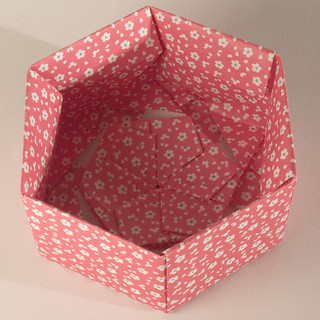
Base of Decorative Hexagonal Origami Gift Box (with Lid removed): # 05


The Fundamental Geometry of the Hexagon
In Euclidean geometry, a hexagon is defined as a six-sided polygon. The term 'polygon' itself originates from Greek words meaning 'many angles.' A simple hexagon is one that does not intersect itself. A key characteristic of any simple hexagon is the sum of its interior angles, which consistently totals 720 degrees.
This property is derived from the general formula for the sum of interior angles of an n-sided polygon, which is (n-2) x 180 degrees. For a hexagon, where n=6, this becomes (6-2) x 180 = 4 x 180 = 720 degrees. A regular hexagon is a special case where all six sides are of equal length, and all six interior angles are equal, each measuring 120 degrees (720 / 6 = 120).
Historical Roots and Mathematical Exploration
The study of geometric shapes, including the hexagon, has a long and rich history, with significant contributions from ancient Greek mathematicians like Euclid. His seminal work, 'Elements,' laid the groundwork for much of modern geometry, detailing the properties of polygons and their relationships. While no single individual 'discovered' the hexagon, its mathematical elegance and practical applications have been recognized and explored across civilizations.
The Greeks were particularly interested in regular polygons and their ability to form perfect tessellations, a concept that continues to be relevant in fields ranging from art to materials science. The consistent mathematical properties of the hexagon have made it a subject of study for millennia.
The Hexagon's Supremacy in Efficiency and Stability
The hexagon's prominence in both nature and engineering is largely due to its remarkable efficiency and structural integrity. Its ability to tessellate, meaning it can tile a plane without gaps or overlaps, is unparalleled among regular polygons. This property is crucial for maximizing space and minimizing material usage.
Bees, for instance, construct their honeycombs using hexagonal cells because this shape requires the least amount of wax to enclose the largest possible area, making it the most efficient design for storing honey. This structural stability also makes hexagons ideal for load-bearing applications. The forces are distributed evenly across the sides and vertices, preventing stress concentrations that could lead to failure, a principle exploited in architectural designs and material science.
From Nature's Design to Human Innovation
The hexagon's influence extends far beyond the bee's hive. In materials science, the hexagonal close-packed (HCP) structure is a fundamental arrangement for many metals and crystals, contributing to their strength and density. The hexagonal lattice is also a common motif in molecular structures, such as in graphene, a single layer of carbon atoms arranged in a honeycomb lattice, known for its exceptional strength and conductivity.
In engineering, hexagonal patterns are found in protective gear, structural components, and even the design of soccer balls, where the hexagonal and pentagonal panels create a nearly spherical shape that is aerodynamically stable. The predictable geometry and inherent strength of the hexagon make it a recurring and vital shape in the natural world and human innovation.
Go deeper
Frequently Asked Questions
What is a hexagon?+
Why do bees build honeycombs with hexagons?+
How many interior degrees does a hexagon have?+
Where can we see hexagons in nature or everyday life?+
What makes hexagons strong for building things?+
Based on content from Wikipedia · Licensed under CC BY-SA 4.0