

Hertzsprung–Russell diagram
Images

Image Hertzsprung-Russell Diagram II


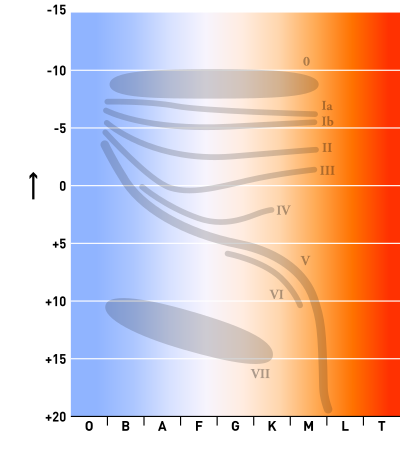

The Genesis of a Cosmic Classification System
The Hertzsprung–Russell (H–R) diagram, first developed independently by Ejnar Hertzsprung around 1911 and Henry Norris Russell in 1913, represents a pivotal moment in astrophysics. Prior to its creation, stars were cataloged primarily by their spectral types, which are indicators of surface temperature. However, the H–R diagram provided a novel way to visualize the relationships between a star's intrinsic properties: its luminosity (or absolute magnitude) and its effective temperature (often derived from spectral classification).
This two-dimensional plot revealed that stars were not randomly distributed but occupied specific regions, suggesting underlying physical processes governing their existence and evolution. The diagram’s initial construction was based on limited data, but its predictive power and explanatory scope quickly established it as a cornerstone of stellar astronomy, fundamentally altering our understanding of the universe's stellar content and dynamics.
Decoding Stellar Life Cycles
The profound significance of the H–R diagram lies in its ability to map stellar evolution. Stars spend the majority of their lives on the main sequence, a diagonal band stretching from the hot, luminous, massive stars at the upper left to the cool, dim, low-mass stars at the lower right. Our Sun is a G-type main-sequence star, positioned roughly in the middle.
As stars exhaust the hydrogen fuel in their cores, they evolve off the main sequence. Massive stars expand into red supergiants, while lower-mass stars like our Sun become red giants before shedding their outer layers to form white dwarfs. The H–R diagram allows astronomers to place stars into these evolutionary tracks, inferring their ages, masses, and ultimate fates.
By studying the distribution of stars within different regions of the diagram, scientists can also deduce information about star formation rates, galactic structure, and the chemical composition of the universe over cosmic time.
The Mechanics of the H–R Diagram
The H–R diagram is constructed with effective temperature (or spectral type) on the horizontal axis, typically increasing from right to left (cool to hot), and luminosity (or absolute magnitude) on the vertical axis, increasing from bottom to top (dim to bright). Several distinct regions emerge: the aforementioned main sequence, the luminous and expansive giants and supergiants above the main sequence, and the hot, dense, low-luminosity white dwarfs below and to the left. The precise location of a star within these regions is dictated by its mass, age, and internal structure.
For instance, a star's position on the main sequence is strongly correlated with its mass; more massive stars are hotter and more luminous. The diagram is not static; it represents a snapshot of stellar populations, and the evolutionary paths of individual stars are traced across different regions over billions of years. Understanding these transitions is key to stellar astrophysics.
Observational Applications and Modern Relevance
The H–R diagram is an indispensable tool for observational astronomy. It is used to determine the distances to star clusters by comparing the apparent magnitude of main-sequence stars to their absolute magnitude. By analyzing the H–R diagrams of different star clusters, astronomers can estimate their ages, providing insights into the history of star formation within galaxies.
Furthermore, the diagram is crucial for testing and refining theoretical models of stellar structure and evolution. Modern astrophysics continues to utilize H–R diagrams, often enhanced with additional data like metallicity or rotation rates, to study exotic stellar objects, the formation of planetary systems, and the properties of stars in different galactic environments, from the Milky Way to distant galaxies. Its enduring utility underscores its fundamental importance in our quest to understand the cosmos.
Beyond the Basics
While the classic H–R diagram plots luminosity versus temperature, variations exist that provide even more detailed information. The Color-Magnitude Diagram (CMD), for instance, plots apparent magnitude against color index (e.g., B-V color), which is a proxy for temperature. CMDs are particularly useful for studying distant star clusters where absolute magnitudes are not directly measurable.
Another related concept is the Mass-Luminosity relation, which shows that more massive stars are significantly more luminous than less massive ones, a relationship that is clearly reflected in the main sequence of the H-R diagram. The study of stellar populations, including their initial mass function (IMF) and chemical enrichment histories, relies heavily on analyzing H-R diagrams of various stellar samples. The diagram also serves as a visual representation of the Hertzsprung gap, a region where few stars are found, indicating a rapid evolutionary phase.
See also
Frequently Asked Questions
What is a Hertzsprung–Russell diagram?+
Why do stars appear in different spots on the diagram?+
How does the diagram show a star's life stage?+
Where can we find the main sequence on the diagram?+
Are the positions of stars on the diagram related to their size?+
Based on content from Wikipedia · Licensed under CC BY-SA 4.0