

Helium-3: The Moon's Special Gas!
Images
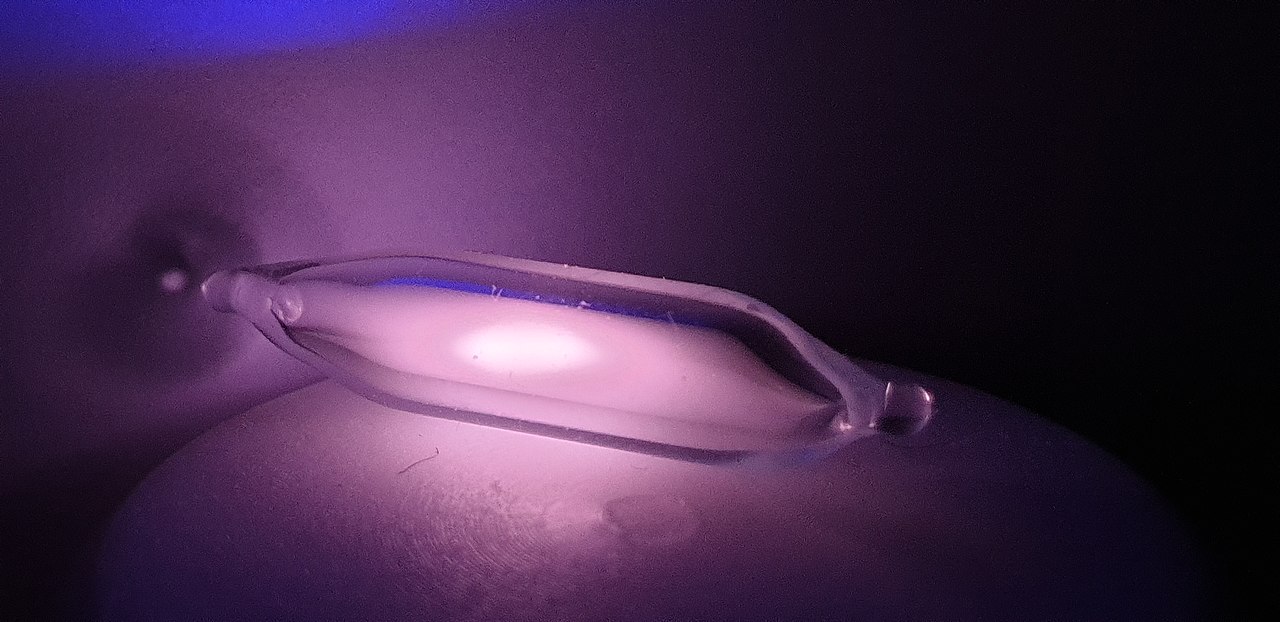
Angeregtes Helium 3


The Peculiar Nature of Helium-3
Helium-3 (³He) stands out in the elemental landscape due to its unique isotopic composition: two protons and a single neutron. This contrasts sharply with the ubiquitous helium-4 (⁴He), which possesses two protons and two neutrons. This neutron deficiency renders ³He lighter and significantly alters its quantum mechanical behavior.
Notably, ³He and protium (¹H) are the only stable nuclides where the number of protons exceeds the number of neutrons. Discovered in 1939, its existence was initially a scientific curiosity, but its rarity on Earth, where it largely escapes into space, hints at a more significant cosmic origin and potential. Its fermionic nature also contributes to its unusual properties at cryogenic temperatures.
Extraterrestrial Abundance
While trace amounts of Helium-3 exist in Earth's atmosphere, often as a byproduct of nuclear weapons testing, its true terrestrial concentration is negligible. The vast majority of Helium-3 is believed to have originated from stellar nucleosynthesis and was incorporated into the solar nebula from which our solar system formed. Over billions of years, the continuous bombardment of the Moon's surface by the solar wind has effectively implanted Helium-3 into the lunar regolith.
Estimates suggest that the Moon's regolith could contain millions of tons of Helium-3, a concentration far exceeding that found anywhere on Earth. This makes the Moon a prime candidate for future resource extraction, though the technological and economic challenges are immense.
Fusion Energy Potential
The primary driver of interest in Helium-3 is its potential as a fuel for aneutronic nuclear fusion. Fusion reactions involving ³He, such as the ³He-³He reaction, produce primarily charged particles (protons and alpha particles) rather than neutrons. This is a critical advantage over deuterium-tritium (D-T) fusion, which is the most readily achievable fusion reaction but generates a high flux of energetic neutrons.
These neutrons activate surrounding materials, leading to significant radioactivity and posing engineering challenges for reactor design and waste management. While ³He fusion might still induce some secondary reactions that cause material activation, the overall reduction in neutron flux offers a pathway to potentially safer, cleaner, and more manageable fusion power generation.
Quantum Marvels
Beyond its energy potential, Helium-3 is a cornerstone of condensed matter physics research due to its remarkable superfluid properties. At temperatures below 2.491 millikelvins (mK), ³He transitions into a superfluid state, exhibiting quantum phenomena like frictionless flow and quantized vortices. This superfluidity allows scientists to probe fundamental aspects of quantum mechanics, such as Bose-Einstein condensation and Fermi liquid theory.
The study of ³He superfluids has provided deep insights into the behavior of matter at extremely low temperatures and high densities, contributing significantly to our understanding of quantum phenomena and the fundamental forces of nature. Its unique properties continue to make it an invaluable tool for cutting-edge scientific exploration.
Challenges and Future Prospects
Despite its promising attributes, the practical utilization of Helium-3 faces substantial hurdles. The primary challenge is its extreme scarcity on Earth and the immense difficulty and cost associated with lunar extraction and transportation. Current terrestrial sources are insufficient for any large-scale application.
Furthermore, achieving sustained and efficient ³He-³He fusion requires overcoming significant technological barriers related to plasma confinement and ignition temperatures, which are still areas of active research. While the vision of Helium-3 powered reactors remains a compelling long-term goal, it necessitates breakthroughs in space mining, propulsion, and fusion reactor engineering. The scientific value of ³He in fundamental research, however, remains undisputed.
See also
Based on content from Wikipedia · Licensed under CC BY-SA 4.0