

Half hull model ship
Images
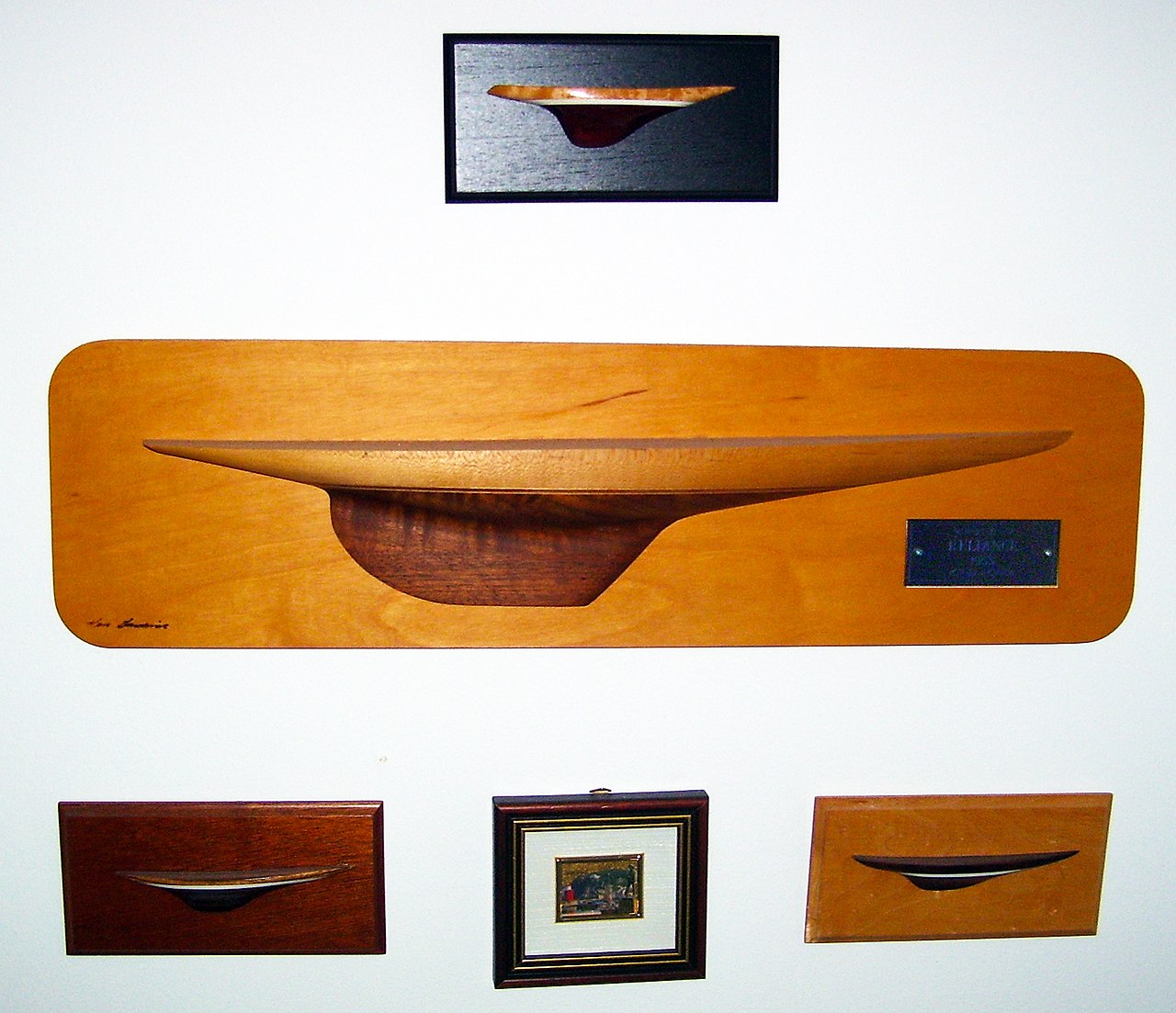
Half hull model ship


The Essence of Form
A half hull model ship is a specialized representation in the field of maritime modeling, focusing exclusively on one lateral half of a vessel's hull. Unlike a complete ship model, which aims to replicate the entire vessel with its masts, rigging, and deck furniture, the half hull is deliberately minimalist. Its primary function is to present the three-dimensional form of the hull itself, the component that interfaces directly with the water.
Typically constructed from wood, these models are meticulously shaped to reflect the precise lines and curves that dictate a ship's performance characteristics. They are often mounted on a flat backboard, which serves as the plane of symmetry, allowing viewers to easily comprehend the hull's overall shape and its potential for buoyancy, stability, and speed. The absence of superstructure and rigging emphasizes the fundamental engineering principles governing a vessel's interaction with its aquatic environment, making it a pure study in hydrodynamic form.
A Legacy of Lines
The practice of creating half hull models is deeply interwoven with the evolution of shipbuilding, dating back to at least the 17th century, and arguably earlier in simpler forms. Before the digital age and the widespread adoption of computer-aided design (CAD) software, physical models were indispensable tools for naval architects and shipwrights. These half hulls served as tangible, scaled representations of proposed vessel designs.
They facilitated critical analysis of hull form, allowing for the visualization of complex curves and the assessment of hydrodynamic efficiency. Builders would meticulously craft these models, often using a technique known as 'bread and butter' construction, where thin planks of wood are glued and shaped sequentially to build up the hull's contours. This method allowed for great accuracy in replicating subtle changes in form.
These models were not merely decorative artifacts; they were functional design aids, essential for communicating design intent, obtaining approval for new ship constructions, and serving as educational tools for apprentices learning the art and science of shipbuilding.
The Unseen Architect
The profound importance of half hull models lies in their direct contribution to naval architectural advancement. They provided a critical bridge between theoretical design concepts and practical application. By allowing for the detailed study and refinement of hull shapes, these models enabled the development of vessels with enhanced performance.
A hull's form dictates its resistance to water flow (drag), its stability in various sea conditions, its maneuverability, and its capacity to carry cargo or personnel. For instance, the development of finer, sharper bows in the age of sail, or the more bulbous bows seen on modern ships, were concepts that could be explored and refined using half hull models. These models were instrumental in optimizing hull designs for specific purposes, whether for speed in warships, efficiency in cargo vessels, or stability in passenger liners.
They represented a tangible manifestation of complex fluid dynamics principles, making them invaluable for innovation and for the standardization of shipbuilding practices across different naval powers and commercial fleets.
The Art and Science of Construction
The construction of a half hull model is a discipline that demands both artistic sensibility and technical precision. The primary method, 'bread and butter' construction, involves cutting multiple thin wooden planks to specific profiles and then laminating them together. Each layer is carefully shaped to contribute to the overall form of the hull.
This technique allows for the accurate representation of complex curvature and the internal structure that would support the hull plating or planking of a full-sized vessel. Alternatively, some models might be carved from a solid block of wood, a process that requires significant skill to avoid errors. The external surfaces are then smoothed and finished to a high standard, often polished or painted, to clearly reveal the hull's lines.
The backboard, typically a piece of darker wood, represents the ship's centerline, providing a stable mounting and a visual reference for the hull's symmetry. The finished half hull is not merely a model but a sophisticated representation of applied naval architecture, embodying the critical design decisions that determine a ship's seaworthiness and performance.
Enduring Relevance
While the advent of advanced digital modeling and simulation software has largely supplanted the traditional role of physical half hull models in the initial design phase, they retain significant value. Historically, they were indispensable tools that directly influenced the design and construction of countless vessels, from majestic tall ships to early steamships. Today, they are highly prized by collectors, maritime museums, and enthusiasts for their historical significance and aesthetic appeal.
They serve as tangible links to the golden age of shipbuilding, offering insights into the craftsmanship and ingenuity of past eras. Furthermore, the principles embodied in the hull shapes represented by these models continue to inform modern naval architecture, even as the methods of visualization and testing have evolved. The half hull model remains a powerful symbol of the fundamental relationship between form and function in maritime design, a testament to how understanding the shape of a hull is key to mastering the sea.
See also
Frequently Asked Questions
What is a half hull model ship?+
Why do people build half hull models instead of full ship models?+
How are half hull models made?+
Where are half hull models used?+
When did people start making half hull models?+
Based on content from Wikipedia · Licensed under CC BY-SA 4.0