

Hadley Cell: Earth's Giant Air Swings!
Images

Hadley cell


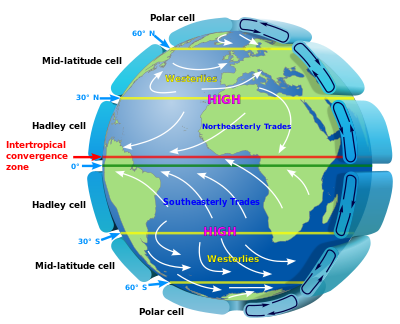


The Energetics of Equatorial Ascent and Polar Descent
The Hadley cell is a fundamental component of the general atmospheric circulation, driven primarily by the uneven distribution of solar radiation across the Earth's surface. The intense insolation at the tropics leads to significant surface heating, warming the overlying air mass and decreasing its density. This buoyancy causes the air to ascend vigorously in the Intertropical Convergence Zone (ITCZ), a region characterized by rising air, convection, and abundant precipitation, forming the planet's wettest climate zones, including tropical rainforests.
As this air rises to the tropopause, it spreads poleward in the upper troposphere. The poleward movement is facilitated by the conservation of angular momentum, causing the air to accelerate and flow towards higher latitudes. This poleward transport is crucial for redistributing heat energy from the tropics towards the cooler polar regions, acting as a vital mechanism in Earth's energy balance.
Subtropical Highs and the Genesis of Arid Zones
As the poleward-moving air in the upper troposphere cools and encounters the descending branch of the circulation, it begins to sink around 30 degrees north and south latitude. This descending air compresses and warms adiabatically, leading to increased atmospheric stability and a reduction in relative humidity. This process is responsible for the formation of persistent high-pressure systems known as subtropical highs (e.g., the Azores High, Pacific High).
These zones of sinking, dry air are characterized by clear skies, minimal precipitation, and are the primary drivers of the world's major arid and semi-arid regions, including the Sahara, Arabian, and Australian deserts. The surface outflow from these high-pressure systems, deflected by the Coriolis effect, forms the prevailing trade winds that blow towards the equator.
Hadley Cells, Jet Streams, and Seasonal Variability
The Hadley cell's strength and position exhibit significant seasonal variability, largely influenced by the Earth's axial tilt and the corresponding shift in the ITCZ. During the summer hemisphere's high-sun period, the ITCZ and the associated Hadley cell tend to migrate poleward, bringing monsoon rains to regions like India and West Africa. Conversely, during winter, they shift equatorward, leading to drier conditions in these areas.
The poleward extent of the Hadley cell is also closely linked to the position and strength of the subtropical jet streams, which are narrow bands of strong westerly winds in the upper troposphere. These jet streams play a critical role in steering weather systems and influencing mid-latitude climate patterns. Understanding the dynamics of the Hadley cell is therefore essential for forecasting seasonal weather and long-term climate trends.
Anthropogenic Influences and Future Climate Projections
There is growing scientific evidence suggesting that anthropogenic climate change may be influencing the Hadley cell. Studies indicate a potential poleward expansion of the Hadley cell, which could lead to drier conditions in subtropical regions and increased rainfall in higher latitudes. This expansion could exacerbate water scarcity in already arid areas and alter precipitation patterns globally.
Furthermore, changes in the intensity of the Hadley cell could impact the frequency and severity of extreme weather events, such as heatwaves and droughts. Research into these changes is crucial for developing effective climate adaptation and mitigation strategies, highlighting the profound and far-reaching implications of this fundamental atmospheric circulation pattern for the future of our planet.
See also
Frequently Asked Questions
What is the Hadley cell and how does it move air around the Earth?+
Why does the Hadley cell make tropical rainforests so wet?+
How does the Hadley cell help keep deserts dry?+
When does the Hadley cell move farther from the equator and why?+
Can human climate change affect the Hadley cell?+
Based on content from Wikipedia · Licensed under CC BY-SA 4.0