

Graviton
Images

Graviton


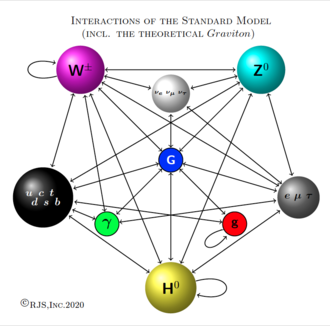


The Graviton
In the realm of theoretical physics, the graviton stands as the hypothetical elementary particle responsible for mediating the force of gravitational interaction. It is a cornerstone concept in attempts to formulate a theory of quantum gravity, which seeks to reconcile Einstein's general relativity with quantum mechanics. Unlike the photon, the quantum of the electromagnetic force, or the gluons and W/Z bosons that mediate the strong and weak nuclear forces respectively, the graviton has yet to be experimentally detected.
Its existence is inferred from the need to quantize the gravitational field, much like other fundamental forces are described by their quantum carriers. The challenge lies in gravity's extreme weakness at the quantum level, making direct observation of gravitons extraordinarily difficult, pushing the boundaries of experimental physics and requiring novel detection strategies.
Theoretical Underpinnings
The predicted properties of the graviton are deeply rooted in the nature of gravity itself. Firstly, because the gravitational force has an infinite range and propagates at the speed of light, the graviton is theorized to be massless. A massive graviton would imply a Yukawa-like potential, leading to a finite range for gravity, which contradicts observations.
Secondly, the source of gravity in general relativity is the stress-energy tensor, a second-order tensor. This mathematical structure dictates that the mediating particle must be a spin-2 boson. This is in contrast to the photon, which mediates electromagnetism, a force sourced by a first-order tensor (the four-current), and is a spin-1 boson.
The mathematical consistency of a massless spin-2 field coupling to the stress-energy tensor in a manner indistinguishable from gravitational interactions strongly suggests that if such a particle exists, it must be the graviton.
Gravitons in String Theory and the Problem of Renormalization
String theory, a leading candidate for a consistent theory of quantum gravity, naturally incorporates the graviton. Within this framework, the graviton is understood not as a point-like particle but as a specific vibrational mode of a fundamental string. This perspective offers a potential resolution to some of the mathematical hurdles faced by other quantum gravity approaches.
A significant obstacle in developing a complete quantum field theory of gravitons has been the problem of renormalization. When attempting to apply standard quantum field theory techniques to gravity, infinities arise that cannot be consistently removed, a problem not encountered with other fundamental forces. String theory, by introducing extended objects (strings) rather than point particles, offers a way to smooth out these infinities and provide a mathematically well-behaved theory that includes the graviton.
The Experimental Challenge
The experimental verification of the graviton remains one of the most formidable challenges in modern physics. The weakness of gravity means that the energy scale at which quantum gravitational effects are expected to become significant, the Planck scale, is vastly beyond the reach of current particle accelerators. Detecting a single graviton would require instruments of unimaginable sensitivity, far surpassing current technological capabilities.
Indirect evidence, such as observing gravitational waves, provides insights into the macroscopic behavior of gravity but does not directly confirm the existence of individual gravitons. While direct detection may be a distant dream, ongoing research in areas like cosmology and astrophysics might offer indirect clues, and theoretical advancements continue to refine our understanding of what properties a detected particle would need to possess to be definitively identified as a graviton.
Broader Implications and Related Concepts
The existence and properties of the graviton have profound implications for our understanding of the universe's fundamental structure. If confirmed, it would validate key aspects of quantum gravity theories and provide a complete picture of the four fundamental forces. Related concepts include the search for a unified field theory, which aims to describe all fundamental forces and particles within a single theoretical framework.
The graviton's spin-2 nature also connects it to the broader class of particles known as bosons, which obey Bose-Einstein statistics and are often associated with force mediation. Understanding the graviton is not just about finding a particle; it's about unlocking the deepest secrets of spacetime, black holes, the Big Bang, and the very fabric of reality.
Go deeper
Based on content from Wikipedia · Licensed under CC BY-SA 4.0