

Gondwana
Images

Gondwana-Laurasia
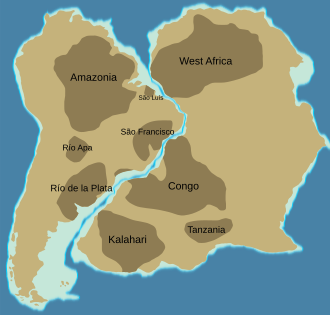


The Accretionary Genesis of Gondwana
Gondwana, a colossal supercontinent that dominated the Southern Hemisphere for a significant portion of Earth's history, was not a primordial entity but rather a product of protracted continental accretion. Its formation began with the amalgamation of several ancient cratons, stable blocks of Earth's crust, commencing around 800 to 650 million years ago (Ma). A key event was the East African Orogeny, marking the collision of the Indian and Madagascar cratons with East Africa.
This process culminated in the Neoproterozoic Era, with the overlapping Brasiliano and Kuunga orogenies between approximately 600 and 530 Ma. These events cemented the assembly of South America with Africa, and the subsequent incorporation of Australia and Antarctica, forming the largest continental landmass of the Paleozoic Era. At its zenith, Gondwana spanned an immense area of roughly 100,000,000 km², representing approximately one-fifth of the Earth's surface.
This vast landmass played a crucial role in global paleoclimate and biogeography before its eventual breakup and integration into Pangaea.
Biogeographic Legacies
The extensive geographic reach of Gondwana facilitated the dispersal and evolution of numerous terrestrial and freshwater taxa across its vast expanse. The subsequent fragmentation of this supercontinent led to the vicariance of these lineages, resulting in the distribution of related species across geographically separated continents. Modern biogeographical studies reveal striking similarities in fossil records and extant species across South America, Africa, India, Australia, and Antarctica, providing compelling evidence of their shared Gondwanan heritage.
For instance, the distribution of ancient plant groups like glossopterids and certain reptilian families (e.g., mesosaurs, cynodonts) across these continents was a direct consequence of their shared habitat on Gondwana. The persistence of these shared faunal and floral elements to the present day serves as a powerful testament to Gondwana's profound and enduring impact on global biodiversity patterns.
The Gradual Disintegration
Gondwana's reign as a unified supercontinent eventually ended due to the relentless forces of plate tectonics. The initial separation from the northern supercontinent, Laurasia, occurred during the Triassic period. However, the more significant fragmentation of Gondwana itself began in earnest during the Early Jurassic, approximately 180 million years ago.
This process was not instantaneous but occurred in stages over millions of years. The breakup involved rifting and the formation of new ocean basins. The final stages of this continental divorce were particularly dramatic, involving the separation of the Antarctic land bridge.
This led to Antarctica drifting away from South America and Australia, creating the deep waters of the Drake Passage and the Tasmanian Passage. These events, primarily occurring during the Paleogene period (from about 66 to 23 million years ago), ultimately shaped the modern configuration of the Southern Hemisphere continents.
Paleogeographic Significance and Modern Relevance
The study of Gondwana is fundamental to understanding Earth's geological and biological history. Its reconstruction provides critical insights into past continental arrangements, ocean circulation patterns, and global climate dynamics. The fit of continental margins, such as the eastern coast of South America and the western coast of Africa, is a direct consequence of their once-shared existence within Gondwana.
Furthermore, understanding Gondwana's breakup is essential for interpreting the distribution of mineral resources, the formation of mountain ranges, and the evolution of life. It helps explain patterns observed in paleomagnetism, paleoclimatology, and evolutionary biology. Gondwana is not merely a relic of the distant past; its legacy is woven into the fabric of our planet's geology and the biodiversity that inhabits it today, offering a crucial framework for deciphering Earth's dynamic evolution.
Go deeper
Frequently Asked Questions
What was Gondwana?+
How did Gondwana form?+
Why did Gondwana break apart?+
Where can we see evidence of Gondwana today?+
How big was Gondwana at its largest?+
Based on content from Wikipedia · Licensed under CC BY-SA 4.0