

Geiger–Marsden experiment
Images

File:Geiger-Marsden experiment expectation and result (Japanese).svg


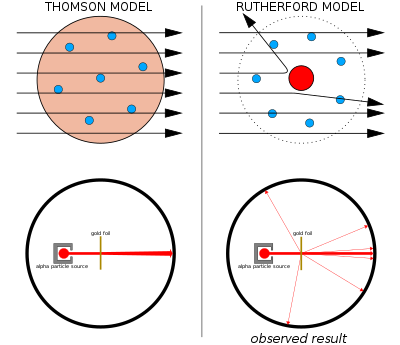


Challenging the Plum Pudding Model
In the early 20th century, the prevailing model of the atom was J.J. Thomson's 'plum pudding' model. This model envisioned the atom as a sphere of diffuse positive charge with negatively charged electrons (like plums in a pudding) embedded within it. Ernest Rutherford, a pioneer in radioactivity research, was not entirely satisfied with this model and sought experimental evidence to confirm or refute it.
He tasked his colleagues, Hans Geiger and Ernest Marsden, with a series of experiments involving the bombardment of thin metal foils with alpha particles, which are helium nuclei emitted by radioactive substances. The expectation, based on the plum pudding model, was that these relatively massive alpha particles would pass through the foil with minimal deflection, perhaps experiencing slight deviations due to the atom's diffuse positive charge.
The Astonishing Anomaly
The Geiger-Marsden experiment, conducted around 1909, involved directing a beam of alpha particles at an extremely thin sheet of gold foil. The scattered particles were detected using a scintillating screen, which produced tiny flashes of light when struck by an alpha particle. While the majority of alpha particles did indeed pass through the foil undeflected, as predicted, a small but significant fraction were deflected at large angles.
Astonishingly, about 1 in 8,000 particles were observed to rebound almost directly backward. This observation was so unexpected that Rutherford famously remarked that it was 'quite the most incredible event that has ever happened to me in my life. It is almost as incredible as if you fired at a 15-inch shell at a piece of tissue paper and it came back and hit you.' This phenomenon became known as Rutherford scattering.
Inferring the Nuclear Atom
The observed scattering pattern could not be explained by the plum pudding model. The large-angle deflections and backscattering indicated that the positive charge and mass of the atom were not spread out but concentrated in a very small, dense region. Rutherford deduced that this region must be at the center of the atom, which he termed the 'nucleus'.
He calculated that the nucleus must be incredibly small, perhaps only about 1/10,000th the diameter of the atom, yet containing almost all of its mass and all of its positive charge. The electrons, he proposed, must orbit this nucleus at a relatively large distance, leaving the atom mostly empty space. This nuclear model of the atom fundamentally altered the landscape of physics and chemistry.
Enduring Legacy and Modern Relevance
The Geiger-Marsden experiment was a landmark achievement that provided the first direct experimental evidence for the nuclear structure of the atom. It marked the end of the plum pudding model and ushered in the era of nuclear physics. The concept of a dense nucleus became the cornerstone of atomic theory, leading to the development of the Bohr model, quantum mechanics, and our understanding of nuclear forces, radioactivity, and nuclear energy.
The techniques developed for detecting scattered particles are still relevant in various scientific fields, including particle physics and materials science. The experiment's legacy is profound, underpinning much of our modern scientific understanding of the universe at its most fundamental level.
See also
Based on content from Wikipedia · Licensed under CC BY-SA 4.0