

Gauss's Law: The Electric Field Detective!
Images

Gauss Sphere Charge Inside


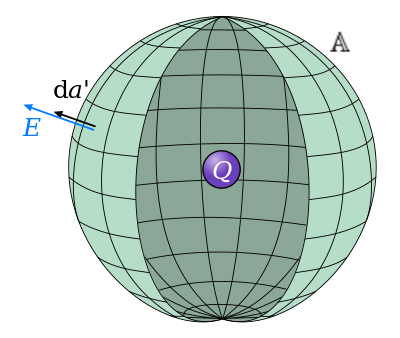
The Elegant Symmetry of Electric Fields
Gauss's Law, one of Maxwell's four fundamental equations, provides a profound insight into the relationship between electric charge and the electric field it generates. Mathematically expressed as $\oint_S \mathbf{E} \cdot d\mathbf{A} = \frac{Q_{enc}}{\epsilon_0}$, this law elegantly states that the total electric flux through any closed surface (a Gaussian surface) is directly proportional to the net electric charge enclosed within that surface.
The constant of proportionality, $\epsilon_0$, is the permittivity of free space, a fundamental constant in electromagnetism. This law is not merely descriptive; it's prescriptive, dictating how electric fields behave in response to charge distributions. It's a powerful tool for simplifying calculations, especially in scenarios exhibiting high degrees of symmetry, such as spherical, cylindrical, or planar charge distributions, where direct integration of Coulomb's law would be significantly more complex.
Historical Roots and Mathematical Evolution
The foundation of Gauss's Law can be traced back to the work of Carl Friedrich Gauss in the 1830s, building upon earlier investigations into electrostatics. Gauss's genius lay in recognizing the power of the divergence theorem, a key result from vector calculus. The divergence theorem relates a surface integral of a vector field to the volume integral of its divergence.
When applied to the electric field, Gauss's Law emerges as a direct consequence, linking the divergence of the electric field to the charge density. This formulation, $ abla \cdot \mathbf{E} = \frac{\rho}{\epsilon_0}$, is the differential form of Gauss's Law and highlights its connection to the local distribution of charge. Its inclusion as one of Maxwell's Equations solidified its place as a pillar of classical electromagnetism, unifying electricity and magnetism.
Profound Implications and Practical Applications
The significance of Gauss's Law extends far beyond theoretical physics. In electrostatics, it provides an indispensable method for calculating electric fields. For instance, by choosing a spherical Gaussian surface around a point charge or a uniformly charged sphere, the electric field can be readily determined.
Similarly, for infinite line charges or infinite planes of charge, cylindrical and planar Gaussian surfaces, respectively, yield straightforward solutions. This predictive power is critical in numerous technological applications. It underpins the design of capacitors, the understanding of electrostatic shielding, the operation of particle accelerators, and the analysis of electric fields in complex materials.
Furthermore, it forms the basis for understanding phenomena like lightning and the behavior of electric fields in the Earth's atmosphere.
The Divergence Theorem
At its heart, Gauss's Law is an application of the divergence theorem, a fundamental theorem in vector calculus. The divergence theorem states that the flux of a vector field out of a closed surface is equal to the integral of the divergence of that field over the volume enclosed by the surface. In the context of electromagnetism, the electric field $\mathbf{E}$ is the vector field, and the divergence of $\mathbf{E}$ is directly proportional to the charge density $\rho$.
Thus, $\oint_S \mathbf{E} \cdot d\mathbf{A} = \int_V ( abla \cdot \mathbf{E}) dV$. Substituting Gauss's Law in its differential form, $ abla \cdot \mathbf{E} = \frac{\rho}{\epsilon_0}$, into the divergence theorem yields $\oint_S \mathbf{E} \cdot d\mathbf{A} = \int_V \frac{\rho}{\epsilon_0} dV$. The integral of charge density over a volume gives the total enclosed charge, $Q_{enc}$, thus recovering the integral form of Gauss's Law.
This mathematical connection highlights the consistency and interconnectedness of fundamental physical laws.
Beyond Electrostatics
While Gauss's Law is most directly applied in electrostatics (where charges are stationary), its inclusion in Maxwell's Equations signifies its role in the broader framework of electrodynamics. In time-varying fields, the law still holds true for the instantaneous electric field and charge distribution. However, the interplay with changing magnetic fields introduces complexities that are fully captured by the complete set of Maxwell's equations.
The other equations, including Faraday's Law of induction and Ampere's Law with Maxwell's addition, describe how electric and magnetic fields generate each other and propagate as electromagnetic waves. Gauss's Law, therefore, represents a crucial piece of the puzzle, defining the static relationship between charge and field, and serving as a foundational element for understanding the dynamic universe of electromagnetism.
See also
Frequently Asked Questions
What is Gauss's Law?+
Why is Gauss's Law useful for solving electric field problems?+
How does Gauss's Law fit into Maxwell's equations?+
Who first discovered Gauss's Law and when?+
What are some everyday things that use Gauss's Law?+
Based on content from Wikipedia · Licensed under CC BY-SA 4.0