

Francis Poulenc
Images

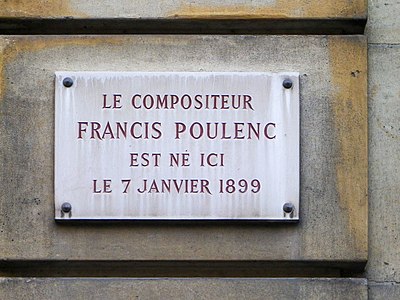
Plaque Place Francis Poulenc - Paris XIX (FR75) - 2021-07-24 - 1



From Avant-Garde Provocateur to Poetic Voice
Francis Jean Marcel Poulenc (1899-1963) emerged as a pivotal figure in 20th-century French music, initially associated with the avant-garde. Born into a prosperous manufacturing family, his path was initially steered towards business, but his innate musical talent led him to private study with the influential pianist Ricardo Viñes. This mentorship proved invaluable, especially after the tragic loss of his parents.
Poulenc soon found himself at the epicenter of Parisian musical innovation, becoming a key member of 'Les Six,' a collective of young composers including Darius Milhaud and Arthur Honegger. Influenced by Erik Satie and Jean Cocteau, 'Les Six' championed a return to clarity, simplicity, and a rejection of Romanticism's excesses, often embracing wit, jazz, and popular idioms. Poulenc's early works, such as the 'Trois mouvements perpétuels' (1919), perfectly encapsulated this spirit with their high-spirited, irreverent, and concise style, earning him a reputation for charming, often witty, compositions.
The Profound Shift
While Poulenc's early output charmed with its effervescence, the 1930s marked a significant turning point in his artistic development. A deeply personal spiritual crisis, triggered by the death of a close friend, led him back to Catholicism and profoundly influenced his creative output. From 1936 onwards, Poulenc began composing a series of intensely moving religious works, including the 'Litanies à la Vierge Noire' and later the monumental 'Stabat Mater' and 'Gloria.' This period saw the emergence of a more serious, introspective, and emotionally resonant voice, which he skillfully integrated with his characteristic melodic gift and clarity.
He never abandoned his lighter style entirely, but the juxtaposition of sacred and secular, the profound and the playful, became a hallmark of his mature output, demonstrating a remarkable ability to navigate and express a wide spectrum of human experience and emotion within his compositions.
A Virtuoso Pianist and a Pioneer of Recording
Beyond his compositional genius, Poulenc was an accomplished pianist, often performing his own works. His collaborations with vocalists were particularly celebrated. His partnership with baritone Pierre Bernac was legendary; Bernac not only performed Poulenc's songs extensively but also provided crucial insights into vocal writing, shaping Poulenc's approach to setting text.
Similarly, his work with soprano Denise Duval, especially in his operas like 'Dialogues des Carmélites' and 'La voix humaine,' showcased his understanding of dramatic vocal expression. Poulenc was also an early adopter of recording technology. Recognizing its potential to disseminate music widely and preserve performances, he began making records in 1928 and continued to do so throughout his career.
This foresight ensured that his interpretations and compositions reached a global audience, solidifying his legacy beyond live performance.
Enduring Relevance
In the decades following his death, Poulenc's reputation in his native France often leaned towards him being a composer of charming, albeit somewhat lightweight, music, with his profound religious and dramatic works sometimes relegated to the background. However, the 21st century has witnessed a significant critical re-evaluation, bringing greater attention to the depth and complexity of his oeuvre. Operas like 'Dialogues des Carmélites' and the one-woman drama 'La voix humaine' have experienced numerous acclaimed international productions, highlighting their psychological acuity and dramatic power.
Furthermore, his extensive song cycles and choral music are increasingly recognized for their emotional sophistication and melodic invention. This contemporary appreciation acknowledges Poulenc not just as a master of wit and elegance, but as a composer capable of profound spiritual expression and intense emotional exploration, securing his place as a vital and multifaceted voice in the classical music canon.
See also
Frequently Asked Questions
What kind of music did Francis Poulenc write?+
Why did Poulenc start writing religious music?+
Who helped Poulenc learn music?+
Which group of composers was Poulenc part of?+
Did Poulenc record his music?+
Based on content from Wikipedia · Licensed under CC BY-SA 4.0