

The Magic of Waves
Images

Fourier series




History
Originally formulated by Joseph Fourier to address the heat equation, the concept has evolved significantly, incorporating modern mathematical tools unavailable during Fourier's era.
Examples
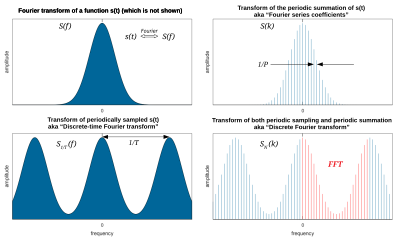
Fourier series are closely related to the Fourier transform, which extends these concepts to non-periodic functions, enabling applications in image processing and data analysis.
Overview
A Fourier series represents a periodic function as an infinite sum of sines and cosines. This decomposition allows for the analysis of complex waveforms through the properties of trigonometric functions.
Importance
The method is essential for solving differential equations and analyzing signal processing. It provides a bridge between time-domain and frequency-domain representations.
How It Works
Coefficients are determined via integration of the function against trigonometric bases. Convergence depends on the function's smoothness; partial sums are used to approximate the original function as more terms are added.
See also
Frequently Asked Questions
What is a Fourier series?+
How does a Fourier series break down patterns?+
Why do scientists use Fourier series?+
Where can I see Fourier series in everyday life?+
What does "periodic function" mean in a Fourier series?+
Based on content from Wikipedia · Licensed under CC BY-SA 4.0