

The Amazing Map Coloring Secret!
Images
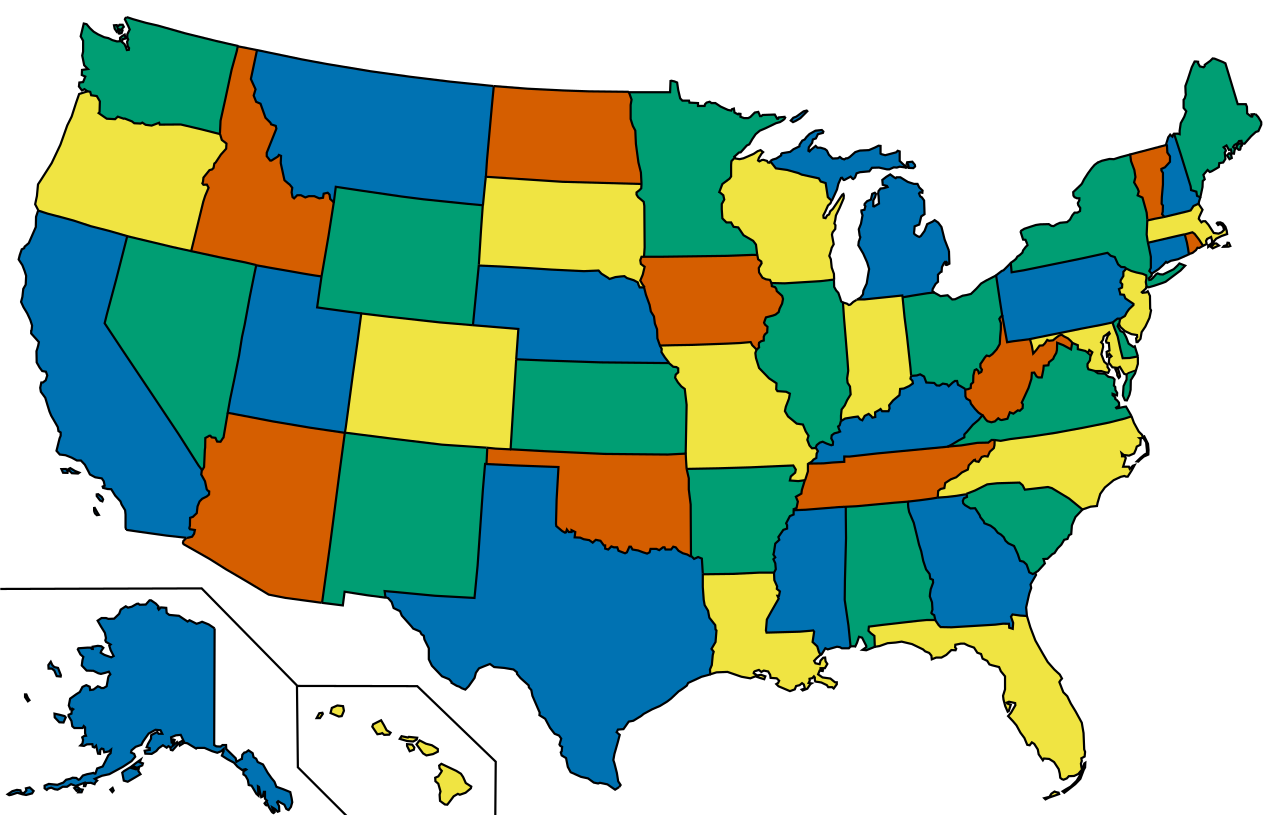
Map of United States accessible colors shown


The Enduring Enigma of Planar Coloring
The Four Color Theorem, a cornerstone of graph theory, posits that any map drawn on a plane can be colored using no more than four distinct colors such that no two adjacent regions share the same hue. Adjacency is defined by sharing a boundary segment of non-zero length, excluding mere point intersections. This seemingly elementary statement resisted rigorous proof for over a century, captivating and frustrating mathematicians alike.
Its allure lies in its simplicity and its profound implications for understanding the fundamental properties of planar graphs. The theorem is a specific instance of the broader concept of chromatic numbers, which measure the minimum number of colors needed to color graph vertices such that no two adjacent vertices share the same color.
From Failed Attempts to Algorithmic Revelation
The theorem's history is a tapestry woven with ingenious but flawed proofs and persistent counterexamples. Early attempts, such as those by Augustus De Morgan and Alfred Kempe, offered promising avenues but ultimately contained critical errors. Kempe's proof, published in 1879, stood for over a decade before Percy Heawood discovered a flaw, though Heawood's work did successfully prove the weaker Five Color Theorem.
The true breakthrough arrived in 1976 with Kenneth Appel and Wolfgang Haken at the University of Illinois. Their proof, a monumental undertaking, relied on a computer to systematically check a vast number of 'reducible configurations' – specific arrangements of regions that could be simplified without affecting the theorem's validity. This computer-assisted approach was revolutionary, marking the first time a major mathematical theorem was proven using computational power, a method initially met with skepticism due to its inaccessibility for manual verification.
The Significance
The Four Color Theorem's significance extends far beyond its colorful conclusion. It fundamentally altered the landscape of mathematical proof, ushering in an era where computational methods could be integral to establishing mathematical truths. The initial resistance to the computer-assisted proof highlighted a philosophical debate about the nature of mathematical certainty and the role of human intuition versus algorithmic verification.
The theorem's proof demonstrated that complex combinatorial problems, previously intractable, could be systematically analyzed and resolved. Furthermore, it spurred advancements in algorithms and computational complexity, influencing fields like computer science, operations research, and even the design of integrated circuits where similar coloring problems arise.
Refining the Proof
The Appel-Haken proof, while groundbreaking, involved an enormous number of cases, estimated to be around 1,936 reducible configurations. This scale made it challenging to fully trust and verify. Subsequent efforts aimed to simplify and strengthen the proof.
In 1997, Neil Robertson, Daniel P. Sanders, Paul Seymour, and Robin Thomas presented an improved proof that reduced the number of configurations to 633, making it more manageable. A significant milestone in formal verification was achieved in 2005 when Georges Gonthier, using the Coq proof assistant software, formally verified the theorem.
This rigorous computational verification provided a high degree of confidence in the proof's correctness, solidifying its place in mathematical literature and demonstrating the power of formal methods in ensuring mathematical rigor.
See also
Frequently Asked Questions
What is the Four Color Theorem?+
Why was it so hard for mathematicians to prove?+
How did computers help solve the problem?+
Who first used a computer to prove the theorem?+
Has the proof been checked again with modern tools?+
Based on content from Wikipedia · Licensed under CC BY-SA 4.0