

Folger Shakespeare Library
Images

Title page from Folger Shakespeare Library STC 22273 Fo.1 no.1



Genesis of a Literary Sanctuary
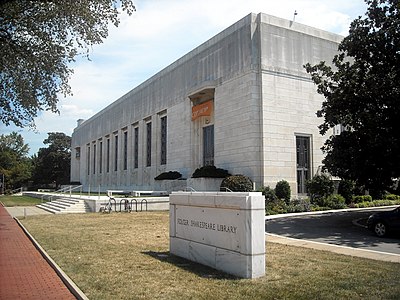
The Folger Shakespeare Library stands as a unique testament to the enduring power of literary preservation and scholarly dedication. Conceived by Henry Clay Folger and Emily Jordan Folger, two passionate bibliophiles, the library was born from a lifelong commitment to amassing the most comprehensive collection of William Shakespeare's printed works. Their vision extended beyond Shakespeare, encompassing a broad spectrum of rare materials from the early modern period in Britain and Europe, roughly spanning 1500 to 1750.
This era was a crucible of intellectual and artistic ferment, and the Folger's holdings provide an invaluable resource for understanding its complexities. The library officially opened its doors in 1932, two years after Henry Folger's passing, fulfilling a shared dream to create a public haven for these irreplaceable historical documents. Its establishment marked a significant contribution to the cultural landscape of Washington, D.C., and the broader academic world.
The Folger's Unrivaled Holdings and Scholarly Mission
At its core, the Folger Shakespeare Library is defined by its unparalleled collection, recognized globally as the largest repository of Shakespeare's printed works. This includes numerous quartos and the precious First Folio, essential primary sources for understanding Shakespeare's texts and their evolution. Beyond Shakespeare, the library safeguards a vast array of rare manuscripts, books, and ephemera from the early modern period.
These materials offer critical insights into the social, political, religious, and cultural contexts of the time, serving as vital evidence for historical research. The Folger actively supports advanced scholarly programs, hosting fellows, researchers, and students who delve into these primary sources. Its mission is to foster a deeper understanding and appreciation of early modern literature and history through meticulous preservation and accessible scholarship.
A Dynamic Cultural and Educational Ecosystem
The Folger transcends the traditional definition of a library by functioning as a vibrant cultural and educational hub. Its programming is designed to engage diverse audiences, from seasoned academics to young learners. The Folger Theatre, an award-winning resident company, produces innovative interpretations of Shakespearean and related plays, demonstrating the continued relevance of these works.
Complementing this is the Folger Consort, an early-music ensemble that performs period-appropriate music, offering an auditory dimension to the historical experience. Furthermore, the library hosts a robust series of public lectures, poetry readings, and exhibitions, often featuring contemporary artists and thinkers in dialogue with historical themes. Its national outreach initiatives, particularly for K-12 educators, are crucial in demystifying Shakespeare and making his works accessible to new generations.
Pioneering Preservation and Institutional Stewardship
The preservation of fragile, centuries-old documents presents immense challenges, and the Folger Shakespeare Library is at the forefront of conservation science. The institution is a leader in developing and implementing cutting-edge methods for the preservation and conservation of rare materials. This involves meticulous environmental controls, specialized repair techniques, and ongoing research into material degradation.
The library's commitment to conservation ensures that these invaluable historical artifacts can be studied and appreciated by future generations. As a privately endowed institution, the Folger is administered by the Trustees of Amherst College, a relationship that provides a stable framework for its long-term stewardship. The recognition of its building on the National Register of Historic Places underscores its architectural and historical significance within the fabric of American heritage.
The Folger's Enduring Relevance in the Digital Age
In an era increasingly defined by digital access, the Folger Shakespeare Library continues to adapt and innovate. While its physical collections remain paramount for in-depth scholarly research, the library is also engaged in digitizing its holdings, making a vast amount of material accessible online to a global audience. This digital expansion complements its traditional role, democratizing access to rare texts and fostering new avenues of research and public engagement.
The Folger's publications, including scholarly journals like Shakespeare Quarterly and accessible editions of plays, further disseminate knowledge. Its ongoing work in performance, education, and preservation solidifies its position not just as a guardian of the past, but as a vital, dynamic force shaping our understanding and appreciation of literature and history today.
See also
Frequently Asked Questions
What is the Folger Shakespeare Library?+
Who started the Folger Shakespeare Library?+
Why is the First Folio important?+
What can kids do at the Folger?+
How does the Folger keep old books safe?+
Based on content from Wikipedia · Licensed under CC BY-SA 4.0