

Faraday's Law of Induction
Images

Faradays Law


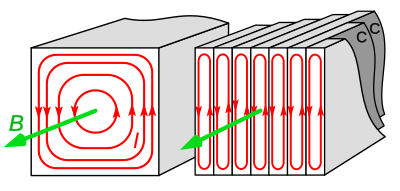


The Maxwell-Faraday Equation and the Genesis of EMF
Faraday's law of induction, formally encapsulated by the Maxwell-Faraday equation, is a fundamental pillar of classical electromagnetism. It states that a time-varying magnetic field is inextricably linked to a circulating electric field. This relationship, often expressed as $ abla \times \mathbf{E} = -\frac{\partial \mathbf{B}}{\partial t}$, quantifies how changes in the magnetic flux density ($\mathbf{B}$) over time ($\frac{\partial}{\partial t}$) induce a curl in the electric field ($ abla \times \mathbf{E}$).
This induced electric field is what drives electric currents in conductive loops. The law applies universally, whether a physical circuit is present or not, describing the behavior of the fields themselves. Historically, this was a profound insight, as it moved beyond static electricity and magnetism to describe their dynamic interplay.
The concept of magnetic flux, which is the measure of the total magnetic field passing through a surface, is central here. A change in this flux, whether due to a changing magnetic field strength or a change in the area or orientation of the surface relative to the field, is the direct cause of the induced EMF.
Michael Faraday's Experimental Genius and Conceptual Evolution
Michael Faraday, a largely self-educated scientist, conducted groundbreaking experiments between 1831 and 1832 that led to the discovery of electromagnetic induction. His meticulous approach involved moving magnets near coils of wire and observing the resulting electrical effects. He distinguished between two mechanisms for generating EMF: 'transformer EMF,' where a changing magnetic field induces an electric field, and 'motional EMF,' where a conductor moves through a magnetic field, and the Lorentz force acts on the charges.
Initially, these seemed to require different explanations, posing a conceptual puzzle. However, the advent of special relativity provided a unified understanding: the distinction between a changing magnetic field and a moving conductor is frame-dependent. What appears as a magnetic force in one inertial frame can be perceived as an induced electric field in another, demonstrating the elegant unity of electromagnetic phenomena across different observers.
The Indispensable Role of Induction in Modern Technology and Energy
The practical implications of Faraday's law are immense, forming the backbone of our electrified world. Electric generators, ubiquitous in power plants, rely on motional EMF to convert mechanical energy from turbines (driven by steam, water, or wind) into electrical energy. Transformers, essential for efficient power transmission, utilize transformer EMF to step up voltages for long-distance transport and step them down for safe use in homes and industries.
Inductors, crucial components in electronic circuits for filtering and energy storage, operate directly on the principle of self-induction, where a changing current in a coil creates its own changing magnetic field, inducing a back EMF that opposes the change. Furthermore, technologies like wireless charging, induction cooktops, and magnetic levitation trains are direct applications of electromagnetic induction. The law is not merely theoretical; it is the engine driving much of our technological progress and energy infrastructure.
Flux Rule vs. Maxwell-Faraday
Faraday's law is often presented in two forms. The Maxwell-Faraday equation describes the induced electric field arising from a changing magnetic field, applicable even in the absence of a conductor. The Faraday flux rule, or Faraday-Lenz law, specifically relates the EMF around a closed loop to the rate of change of magnetic flux through that loop, often written as $\mathcal{E} = -\frac{d\Phi_B}{dt}$.
The negative sign, due to Lenz's Law, indicates that the induced current will flow in a direction that opposes the change in magnetic flux that produced it. This rule encompasses both transformer EMF (where the magnetic field itself changes) and motional EMF (where the conductor moves, changing the flux linkage). The unified relativistic view reconciles these, highlighting that the EMF is a gauge-invariant quantity, meaning it is independent of the observer's frame of reference, even though the specific contributions from electric and magnetic fields might vary.
See also
Frequently Asked Questions
What is Faraday's law of induction?+
How does a changing magnetic field create electricity?+
What is the difference between transformer EMF and motional EMF?+
Why do we use Faraday's law in power plants and transformers?+
How does Faraday's law help with wireless charging or induction cooktops?+
Based on content from Wikipedia · Licensed under CC BY-SA 4.0