

Exponential distribution
Images
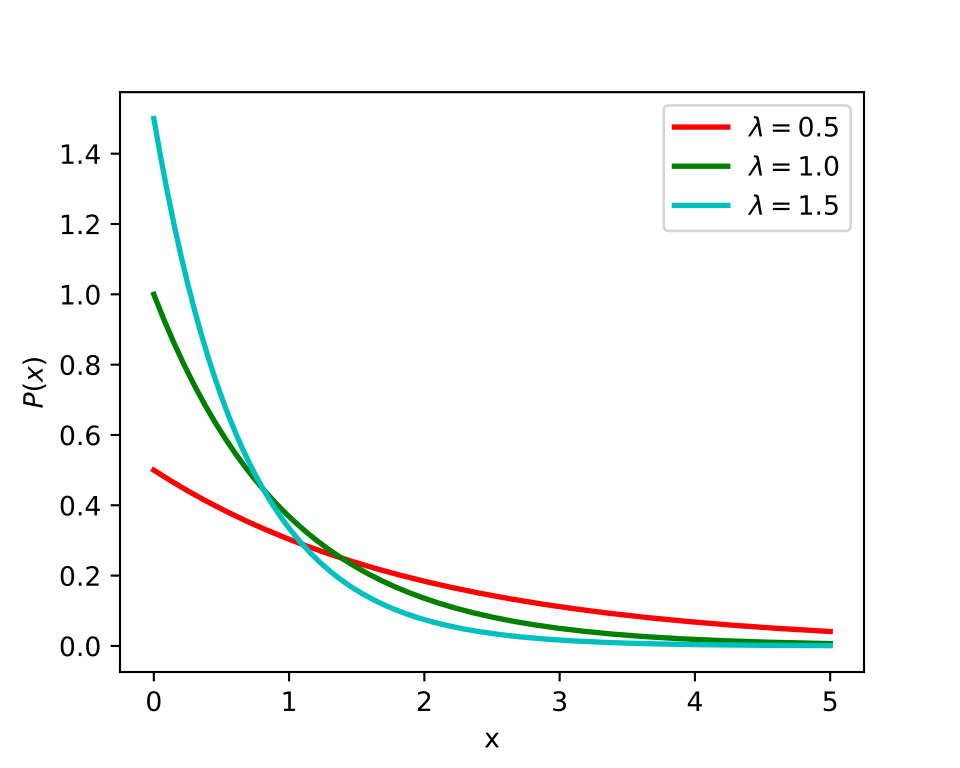
Exponential distribution
The Mathematical Foundation of Exponential Distribution
The exponential distribution is a cornerstone of probability theory, specifically designed to model the time elapsed until a single event occurs in a Poisson process. A Poisson process is characterized by events occurring at a constant average rate, independently of the time since the last event. The probability density function (PDF) of the exponential distribution is given by f(x; λ) = λe^(-λx) for x ≥ 0, where λ > 0 is the rate parameter.
The cumulative distribution function (CDF) is F(x; λ) = 1 - e^(-λx), which represents the probability that the event occurs by time x. This distribution is unique in its 'memoryless' property: P(X > s+t | X > s) = P(X > t). This means that if an event has not occurred by time s, the probability that it will occur in the next t units of time is the same as the probability of it occurring in the first t units of time, regardless of s.
This characteristic makes it incredibly powerful for modeling systems where past performance does not influence future outcomes.
Historical Roots and Evolution of the Concept
The conceptual underpinnings of the exponential distribution can be traced back to the 17th and 18th centuries with the development of probability theory by mathematicians like Christiaan Huygens and Jacob Bernoulli, who explored concepts of chance and expectation. However, its formalization as a distinct distribution is more closely linked to the study of random processes in the 19th and early 20th centuries. Siméon Denis Poisson's work on the distribution of rare events (now known as the Poisson distribution) provided a crucial link, as the time between events in a Poisson process follows an exponential distribution.
Later, mathematicians and physicists like Andrey Kolmogorov and others rigorously developed the theory of stochastic processes, solidifying the exponential distribution's place in describing phenomena like radioactive decay, the lifespan of electronic components, and the waiting times in queuing systems. Its utility was amplified with the rise of statistical mechanics and reliability engineering.
Profound Significance and Applications in Modern Science
The significance of the exponential distribution lies in its ability to provide a mathematical framework for understanding and predicting random waiting times, which are ubiquitous in the natural and engineered world. In reliability engineering, it's fundamental for estimating the Mean Time Between Failures (MTBF) of components and systems, enabling proactive maintenance schedules and enhancing product longevity. For instance, predicting when a server might crash or a hard drive might fail often relies on exponential models.
In telecommunications, it's used in queuing theory to analyze the performance of communication networks, optimizing buffer sizes and call center staffing to minimize customer wait times. Furthermore, in physics, it's essential for describing the decay rates of unstable particles and the time intervals between photon emissions. Its simplicity and the 'memoryless' property make it an indispensable tool for modeling a vast array of real-world stochastic phenomena.
Mechanisms and Mathematical Underpinnings
The exponential distribution arises naturally when considering events that occur at a constant average rate, independent of prior occurrences. If the number of events in a fixed interval follows a Poisson distribution with rate λ, then the time between consecutive events follows an exponential distribution with the same rate parameter λ. The rate parameter λ is crucial; it represents the average number of events per unit of time.
A higher λ signifies a more frequent occurrence of events and thus shorter average waiting times. The distribution's lack of memory is a direct consequence of the Poisson process's independence assumption. This means that if you are waiting for an event, and a certain amount of time has already passed without it occurring, your expectation for how much additional time you will have to wait remains unchanged.
This property simplifies many analytical models, although it also means the distribution is not suitable for all waiting time scenarios, particularly those with aging effects.
Diverse Real-World Manifestations and Extensions
The exponential distribution manifests in numerous practical scenarios. In computer science, it models the time between requests to a web server or the duration of network connections. In finance, it can approximate the time until a credit default or the occurrence of a significant market event, though more complex models are often used for financial time series.
In medicine, it can be applied to model the time until a patient experiences a specific adverse event after a treatment, or the time between successive arrivals at an emergency room. Extensions of the exponential distribution, such as the Weibull distribution and the Gamma distribution, are used when the 'memoryless' property doesn't hold, allowing for more complex aging or learning effects in the system being modeled. These extensions provide greater flexibility in capturing the nuances of real-world waiting times.
See also
Frequently Asked Questions
What is an exponential distribution?+
Why does the exponential distribution have a "memoryless" property?+
How does the exponential distribution help with computers or servers?+
Where do we see exponential distribution in everyday life?+
What do the symbols λ and x mean in the exponential distribution?+
Based on content from Wikipedia · Licensed under CC BY-SA 4.0