

Exploration of Uranus
Images

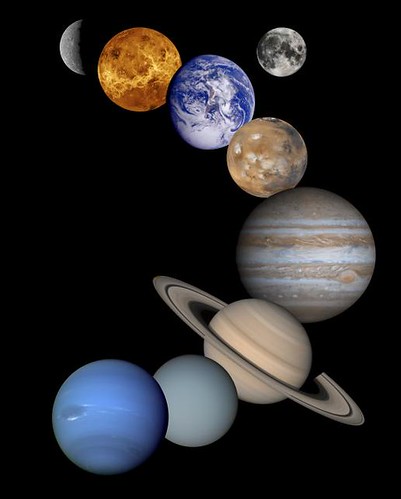
Moons of Saturn, Uranus and Earth


Uranus
Uranus, the seventh planet from the Sun, represents a distinct category of celestial bodies: the ice giants. Unlike the gas giants Jupiter and Saturn, which are predominantly hydrogen and helium, Uranus and Neptune are characterized by a higher proportion of 'ices' – volatile compounds such as water, ammonia, and methane – surrounding a rocky core. This composition contributes to their higher densities.
Uranus's most striking characteristic is its extreme axial tilt of approximately 98 degrees, a phenomenon believed to be the result of a colossal impact event early in the solar system's history. This tilt leads to highly unusual seasonal variations, with each pole enduring decades of continuous sunlight and darkness. The planet's atmosphere is a frigid mix of hydrogen, helium, and methane, the latter absorbing red wavelengths of sunlight and imparting Uranus with its characteristic pale blue-green appearance.
Its magnetic field is also peculiar, being significantly tilted relative to its rotational axis and offset from the planet's center, suggesting a complex generation mechanism within its interior.
Voyager 2's Solitary Grand Tour of Uranus
The exploration of Uranus has been remarkably sparse, with NASA's Voyager 2 spacecraft undertaking the only close-up reconnaissance mission to date. On January 24, 1986, Voyager 2 executed a precisely calculated flyby, gathering a wealth of scientific data during its brief transit through the Uranian system. This mission was a testament to the ingenuity of space exploration, given the immense distance to Uranus and the decades-long journey required.
Voyager 2's sophisticated instrumentation allowed for unprecedented observations of Uranus's atmosphere, magnetic field, and its intricate system of rings and moons. The spacecraft's cameras captured the first high-resolution images of the planet and its satellites, revealing geological features and atmospheric phenomena previously unknown. The data transmitted by Voyager 2 provided the foundational understanding of Uranus that continues to inform scientific inquiry and guide future mission concepts.
Scientific Imperatives
The study of Uranus holds significant scientific value for several key reasons. As one of only two ice giants in our solar system, Uranus provides a crucial data point for understanding the formation and evolution of planetary systems, particularly those beyond the terrestrial planets. Its unique composition and extreme axial tilt offer insights into the dynamic processes that shape planetary bodies, including the potential for catastrophic impacts in the early solar system.
Investigating Uranus's peculiar magnetic field helps scientists refine models of planetary dynamos and the generation of magnetic fields. Furthermore, understanding the atmospheric dynamics and seasonal variations of an ice giant contributes to our broader knowledge of planetary climates. The study of its moons and rings also sheds light on the processes of satellite formation and the dynamics of planetary ring systems, offering comparative context for our own solar system and exoplanetary systems.
Voyager 2's Revelatory Findings and Unanswered Questions
Voyager 2's encounter with Uranus yielded a trove of groundbreaking discoveries. It identified 11 new moons, increasing the known count to 15, and provided detailed imagery of five of them, including the geologically active Miranda. The mission also discovered two new, faint rings and characterized the existing ones, noting their narrowness and dark composition, which contrasts sharply with Saturn's bright, icy rings.
A pivotal finding was the discovery of Uranus's highly unusual magnetic field, which is tilted by 60 degrees relative to the planet's rotation axis and offset from its center by about one-third of the planet's radius. This anomaly suggests that the magnetic field is generated in a shell of electrically conductive fluid, possibly a mixture of water, ammonia, and methane, located relatively close to the surface. The spacecraft also confirmed the extremely low atmospheric temperatures, averaging around -216 degrees Celsius (-357 degrees Fahrenheit), and observed subtle atmospheric features, including a few clouds and storms, challenging earlier assumptions of a featureless atmosphere.
See also
Frequently Asked Questions
What spacecraft visited Uranus and when?+
How many new moons did Voyager 2 discover around Uranus?+
Why does Uranus have a pale blue‑green color?+
What did Voyager 2 learn about Uranus's magnetic field?+
How did Voyager 2 help scientists understand Uranus's seasons?+
Based on content from Wikipedia · Licensed under CC BY-SA 4.0