

Europasaurus: The Tiny Giant Lizard!
Images
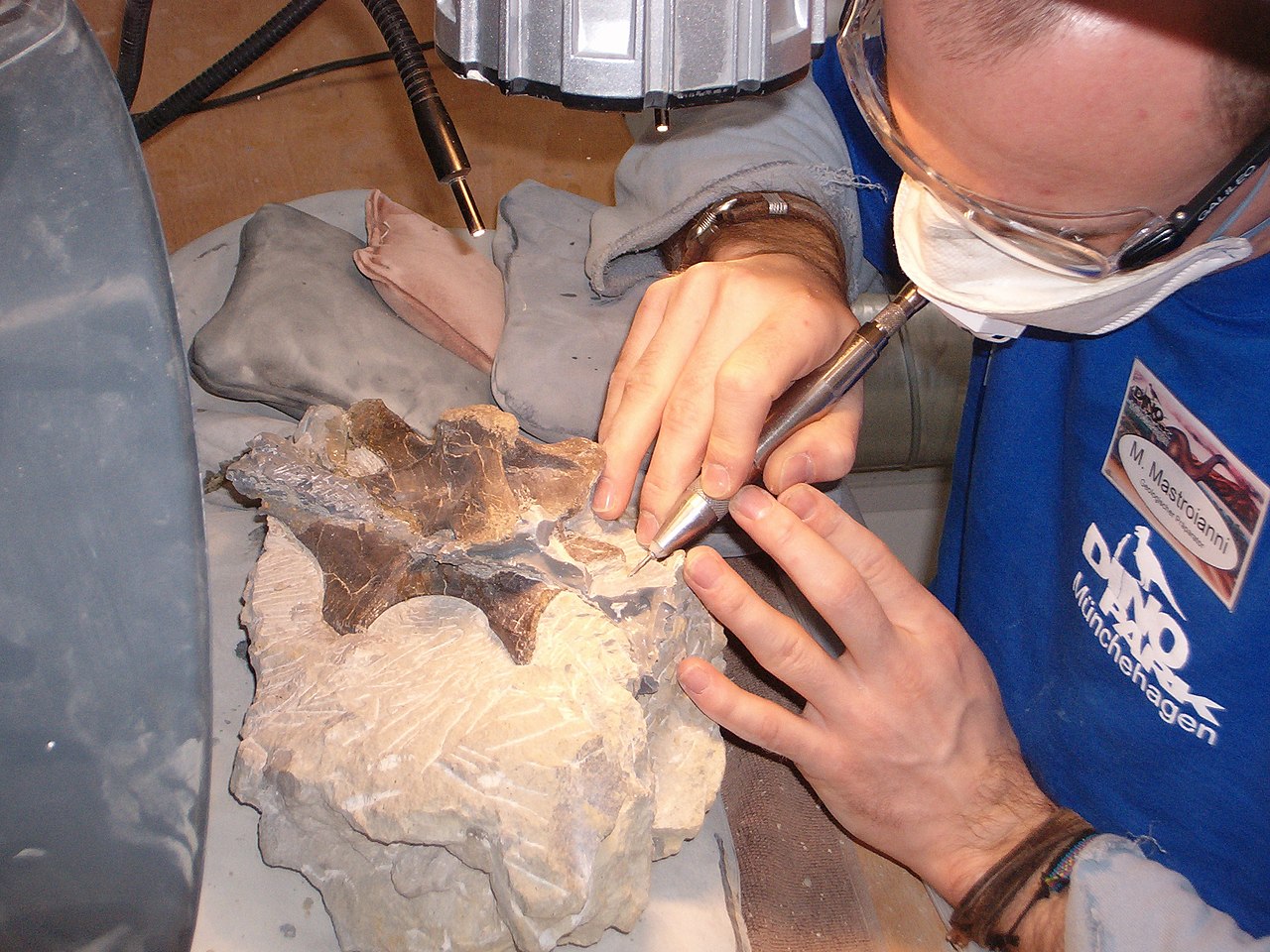
Europasaurus Praeparation


The Unexpected Diminutive
Europasaurus represents a fascinating divergence within the sauropod lineage, specifically among the macronarians. Living during the middle Kimmeridgian stage of the Late Jurassic (approximately 154 to 151 million years ago), its fossils have been unearthed in northern Germany, within the geological context of the Lower Saxony basin. This basin was characterized by a complex archipelago of islands during the Mesozoic era.
Unlike its colossal relatives, such as Brachiosaurus or Diplodocus, Europasaurus exhibits a striking reduction in size. This phenomenon is a classic example of insular dwarfism, a well-documented evolutionary process where isolated populations on islands tend to evolve smaller body sizes compared to their continental counterparts. The discovery of Europasaurus challenges the prevailing notion that all sauropods were uniformly gigantic, highlighting the significant impact of environmental isolation on morphological evolution within a well-established dinosaur group.
Island Biogeography and the Genesis of Europasaurus
The ecological conditions of the Late Jurassic islands in the Lower Saxony basin were pivotal in shaping Europasaurus. These islands, separated by shallow seas, presented unique challenges and opportunities for colonizing fauna. A population of larger sauropods, likely ancestral to Europasaurus, became geographically isolated on one or more of these landmasses.
On islands, resources such as food and space are often limited, and predator-prey dynamics differ significantly from continental settings. In this environment, smaller individuals would have possessed a survival advantage, requiring less food and potentially being more agile. This selective pressure would have favored the genes responsible for smaller size, leading to a gradual decrease in average body mass over successive generations.
The resulting Europasaurus, estimated to be around 6-7 meters in length, is a testament to the powerful influence of island biogeography on evolutionary trajectories, demonstrating that gigantism was not an inevitable outcome for all sauropods.
Dietary Adaptations and Paleoecological Role
As a herbivore, Europasaurus's diet was dictated by the available flora of its island habitat. The vegetation would have consisted of plants adapted to island conditions, likely including various ferns, cycads, and possibly early conifers. While its exact feeding mechanisms are inferred from its skeletal structure, its relatively long neck, though not as extreme as in some mainland sauropods, would have allowed it to browse on vegetation at different heights.
The limited biomass on islands often necessitates efficient foraging strategies. Europasaurus likely played a crucial role in shaping the island's vegetation through its grazing and browsing activities, influencing plant community structure. Its existence highlights how even smaller herbivores can have a significant ecological impact within their localized environments, contributing to the overall functioning of the island ecosystem.
Significance for Paleontological Research and Evolutionary Theory
The discovery and study of Europasaurus hold considerable significance for paleontology and evolutionary biology. It provides concrete evidence for insular dwarfism in large terrestrial vertebrates during the Mesozoic era, a phenomenon previously more extensively documented in mammals and birds. This finding broadens our understanding of the adaptive plasticity of dinosaurs and underscores the importance of paleoenvironmental reconstructions in interpreting fossil evidence.
Europasaurus serves as a critical case study for examining how geographical isolation, resource availability, and ecological pressures can drive divergent evolutionary pathways within a single taxonomic group. It encourages a more nuanced view of dinosaur diversity, moving beyond generalizations about size and highlighting the complex interplay between organism and environment that has shaped life on Earth.
See also
Frequently Asked Questions
What was Europasaurus and how big was it?+
Why was Europasaurus smaller than other sauropods?+
Where were Europasaurus fossils found?+
What did Europasaurus eat?+
Why is Europasaurus important for scientists?+
Based on content from Wikipedia · Licensed under CC BY-SA 4.0