

Equisetum: The Horsetail Plant!
Images

Equisetum


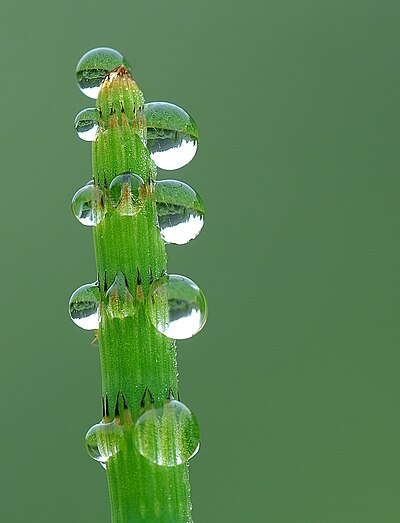

Morphological and Reproductive Uniqueness in Equisetum
The genus Equisetum stands apart in the plant kingdom due to its distinctive morphology and reproductive strategies, offering a window into early land plant evolution. Unlike angiosperms and gymnosperms, horsetails reproduce via spores produced in specialized structures called strobili, typically located at the tips of fertile stems. These spores are wind-dispersed and require moist conditions to germinate, leading to the development of small, gametophyte-dominant structures that produce sperm and eggs.
The vegetative stems are characterized by nodes and internodes, often with whorls of reduced leaves or branches at the nodes, and a prominent central hollow canal. A key distinguishing feature is the high concentration of silica, particularly in the epidermis, which provides structural support and defense against herbivores, contributing to their abrasive texture. This unique combination of primitive reproductive methods and specialized vegetative structures underscores their evolutionary distinctiveness.
Ecological Niches and Global Distribution
Equisetum species exhibit remarkable adaptability, colonizing a broad spectrum of habitats globally, though they predominantly favor moist to wet environments. Their distribution is cosmopolitan, found across temperate and tropical regions of the Northern and Southern Hemispheres, excluding only Antarctica and Australia (though present in New Zealand). Common habitats include riverbanks, lake shores, marshes, ditches, and damp woodlands.
Their ability to thrive in these niches is facilitated by their efficient vegetative propagation via extensive rhizome systems, allowing them to form dense, clonal stands. These stands play a significant ecological role by stabilizing soil, preventing erosion in riparian zones, and contributing to wetland biodiversity. Some species can be considered invasive in certain agricultural or disturbed settings due to their vigorous growth and resilience.
Historical Significance and Modern Applications
The high silica content of Equisetum has historically made it valuable for human use, earning it the common name 'scouring rush.' For centuries, its abrasive stems were employed as a natural abrasive for polishing wood and metal, cleaning, and even as a fine-grit sandpaper. This practical application highlights a direct utilization of its unique mineral composition. Beyond its abrasive properties, various Equisetum species have a long tradition in herbal medicine.
They have been used as diuretics, astringents, and for treating a range of conditions, including kidney and bladder issues, and wound healing. Modern research continues to investigate the phytochemical constituents, such as flavonoids and phenolic acids, for potential therapeutic benefits, although clinical evidence for many traditional uses remains limited. The genus also holds cultural significance, appearing in art and literature as a symbol of resilience and antiquity.
Evolutionary Context and Scientific Interest
Equisetum represents the sole surviving genus of the Equisetopsida class, a group that was once diverse and abundant during the Carboniferous period, forming vast forests alongside lycophytes and ferns. The fossil record reveals giant horsetails, such as Calamites, that grew to tree-like proportions, dominating ancient swamp ecosystems. The persistence of Equisetum to the present day makes it an invaluable subject for paleobotanical and evolutionary studies, providing direct evidence of ancient plant forms and adaptations.
Its unique genetic makeup and physiological processes offer insights into the development of vascular tissues, spore dispersal mechanisms, and the evolution of plant resilience in diverse environmental conditions. Studying Equisetum helps scientists reconstruct ancient ecosystems and understand the long-term evolutionary trajectories of plant life on Earth.
See also
Frequently Asked Questions
What does a horsetail plant look like?+
How do horsetails spread and grow new plants?+
Why are horsetails called "scouring rush"?+
Where can you find horsetails in nature?+
How do horsetails reproduce?+
Based on content from Wikipedia · Licensed under CC BY-SA 4.0