

Energy Level: The Secret Steps of Atoms!
Images

Energy level





The Birth of Quantization
The concept of energy levels arose from a profound crisis in classical physics at the turn of the 20th century. Classical mechanics predicted that electrons orbiting an atomic nucleus, being charged particles, should continuously radiate energy and spiral inward, causing atoms to collapse. This clearly did not happen. Max Planck's work on blackbody radiation in 1900 introduced the idea that energy is emitted or absorbed in discrete packets, or 'quanta,' proportional to frequency (E=hf). Albert Einstein extended this, proposing light itself consists of quanta (photons). Niels Bohr, in 1913, synthesized these ideas by postulating that electrons in atoms could only occupy specific, stable orbits, each corresponding to a discrete energy level.
Electrons could transition between these levels by absorbing or emitting photons with energy precisely matching the difference between the levels. This marked a radical departure from classical physics, introducing the concept of quantization into atomic structure.
Quantum Mechanical Formalism
While Bohr's model was a crucial step, it was ultimately superseded by a more complete quantum mechanical description. In quantum mechanics, electrons are not viewed as orbiting particles but as wave functions, described by the Schrödinger equation. For a bound system, like an electron in an atom, the solutions to this equation yield a set of allowed energy states, the energy levels.
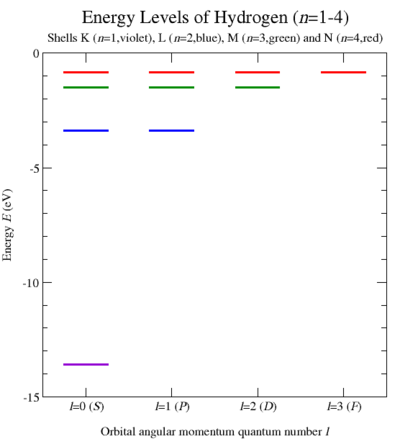
These levels are characterized by quantum numbers. The principal quantum number (n = 1, 2, 3...) broadly corresponds to the energy level or electron shell. Higher values of n indicate higher energy and greater average distance from the nucleus.
Within each shell, further quantum numbers (angular momentum l, magnetic m_l, and spin m_s) define specific orbitals, which are regions of space where an electron is likely to be found. The energy levels are often degenerate, meaning multiple distinct quantum states can share the same energy value.
Spectroscopy and the Fingerprint of Atoms
The discrete nature of energy levels has profound experimental consequences, most notably in spectroscopy. When atoms or molecules absorb or emit energy, they do so at specific frequencies corresponding to the energy differences between their levels. This results in characteristic absorption and emission spectra, which act like unique fingerprints for each element or compound.
By analyzing the wavelengths of light absorbed or emitted, scientists can identify the composition of stars, diagnose diseases, and develop new technologies. For instance, the bright lines in an emission spectrum of hydrogen, explained by Bohr's model, were among the first confirmations of quantized energy levels. Modern spectroscopy, utilizing lasers and advanced detectors, probes these energy transitions with incredible precision, revealing intricate details about molecular vibrations, rotations, and electronic structures.
Electron Shell Structure and Chemical Behavior
The arrangement of electrons into energy levels, or shells, dictates an atom's chemical properties. Electrons preferentially occupy the lowest available energy levels. The first shell (n=1) can hold a maximum of 2 electrons (K shell).
The second shell (n=2) can hold up to 8 electrons (L shell), and the third (n=3) up to 18 (M shell), following the formula 2n². Atoms tend to fill their outermost electron shells to achieve stability, often by gaining, losing, or sharing electrons with other atoms. This tendency drives chemical bonding and the formation of molecules.
The number of electrons in the outermost shell, the valence shell, is the primary determinant of an element's reactivity and the types of compounds it can form. Understanding energy levels is therefore fundamental to comprehending the vast diversity of chemical reactions and material properties.
See also
Based on content from Wikipedia · Licensed under CC BY-SA 4.0