

Tiny Building Blocks of Everything!
Images

Standard Model of Elementary Particles hr


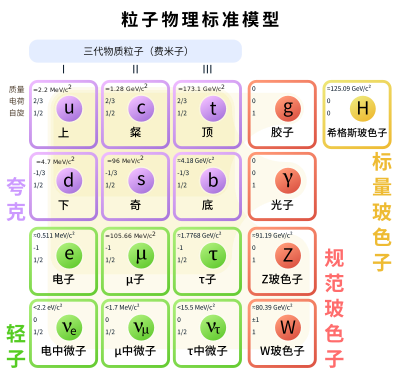
The Unseen Architects
At the heart of particle physics lies the concept of the elementary particle, defined as a subatomic particle that is not composed of other, smaller constituents. These are the irreducible building blocks of the cosmos, the ultimate constituents of matter and force carriers. The prevailing framework for understanding these particles is the Standard Model, which meticulously categorizes 17 distinct elementary particles.
These are broadly classified into fermions, the fundamental constituents of matter, and bosons, which mediate the fundamental forces. Fermions are further divided into quarks and leptons, each with unique properties and interactions. The Standard Model, while incredibly successful, acknowledges that it is not a complete theory, hinting at phenomena beyond its current scope.
The sheer variety, including different 'flavors' and 'colors' for quarks, and the existence of antimatter counterparts, leads to a complex array of particle variations, totaling 48 known fermion types and 13 boson types.
A Historical Odyssey
The notion of fundamental particles has evolved dramatically. Ancient Greek philosophers proposed the atomos, meaning 'uncuttable,' as the smallest unit of matter. This idea persisted for millennia, with the actual existence of atoms only gaining solid scientific footing in the early 20th century, notably through Albert Einstein's work on Brownian motion, which demonstrated the reality of molecules. The subsequent discovery of subatomic constituents revolutionized physics.
The electron, identified in the late 19th century, was the first crack in the atom's perceived indivisibility. This was followed by the proton in 1919, the photon in the 1920s, and the neutron in 1932. The advent of quantum mechanics fundamentally altered the definition of a particle, introducing the wave-particle duality, where particles exhibit characteristics of both waves and discrete entities, existing as probability waves rather than fixed points.
The Standard Model's Pantheon
The Standard Model elegantly organizes the known elementary particles into two main categories: fermions and bosons. The twelve fermions are the building blocks of matter. These include six 'flavors' of quarks (up, down, charm, strange, top, bottom) and six 'flavors' of leptons (electron, muon, tau, and their corresponding neutrinos).
Quarks combine to form composite particles like protons and neutrons. The five fundamental bosons are the force carriers: the photon (electromagnetism), the W and Z bosons (weak nuclear force), and the gluon (strong nuclear force). The Higgs boson is unique, responsible for imparting mass to other elementary particles.
The intricate interplay of these particles and forces governs all known physical phenomena, from the structure of atoms to the fusion reactions within stars.
Beyond the Standard Model
While the Standard Model is a triumph of modern physics, it leaves many questions unanswered, prompting theoretical extensions. One prominent idea is supersymmetry (SUSY), which postulates that every known elementary particle has a 'superpartner' with different spin properties. If confirmed, SUSY would double the number of known elementary particles, introducing particles like selectrons and squarks.
However, these 'superpartners' are predicted to be far more massive than their Standard Model counterparts, making them incredibly difficult to detect. Experiments at particle accelerators like the Large Hadron Collider (LHC) are actively searching for evidence of these hypothetical particles, as well as other phenomena not explained by the Standard Model, such as dark matter, dark energy, and gravity's place in the quantum realm. The search for a more comprehensive theory, potentially unifying all forces and particles, continues to drive cutting-edge research.
See also
Based on content from Wikipedia · Licensed under CC BY-SA 4.0