

Earth's Mantle: The Planet's Secret Layer!
Images

Peridot from Deep Inside the Earth's Mantle




The Mantle's Rheology
The Earth's mantle, a substantial layer extending from the base of the crust down to the core-mantle boundary, is primarily composed of silicate rocks rich in magnesium and iron. While often described as solid, its behavior on geological timescales is far more complex. The immense pressures and temperatures within the mantle, ranging from approximately 1,000°C (1,832°F) at the top to over 3,700°C (6,692°F) at the bottom, cause it to exhibit ductile or viscous flow.
This rheological property means that over millions of years, the mantle deforms and flows like an extremely viscous fluid, akin to solid wax or very thick caramel. This slow, continuous movement is the fundamental driver of plate tectonics, the process that shapes Earth's surface through the movement of lithospheric plates.
The Driving Force of Plate Motion
The primary mechanism responsible for mantle movement is thermal convection. Heat generated from radioactive decay within the mantle and residual heat from Earth's formation creates temperature gradients. Denser, cooler material sinks, while hotter, less dense material rises, establishing slow-moving convection cells. These cells exert drag on the overlying lithospheric plates, causing them to move.
At mid-ocean ridges, upwelling mantle material partially melts due to decompression, forming basaltic magma that solidifies into new oceanic crust. Conversely, at subduction zones, denser oceanic plates sink back into the mantle, carrying water with them. This water lowers the melting point of the surrounding mantle rock, triggering melting and the formation of magma that can rise to create volcanic arcs and continental crust.
Mantle Dynamics and Crustal Genesis
The mantle is not a uniform layer; it's a dynamic system where chemical and thermal heterogeneities play significant roles. Partial melting within the mantle is the direct source of all crustal material. Oceanic crust, primarily basalt, is generated at divergent plate boundaries (mid-ocean ridges) through fractional crystallization of rising mantle melts.
Continental crust, which is more silica-rich and less dense, is generated through more complex processes involving subduction zones, where mantle wedge melting, assimilation of crustal material, and fractional crystallization contribute to its formation. The composition and evolution of the mantle therefore directly influence the type and distribution of crustal rocks found on Earth's surface.
Scale and Composition
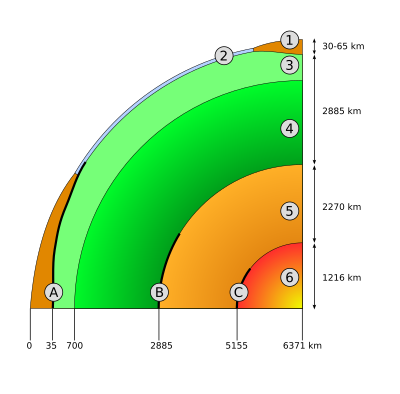
The sheer scale of the mantle is staggering, comprising approximately 84% of Earth's volume and 67% of its mass. Its thickness of 2,900 kilometers (1,800 miles) represents a significant portion of the planet's radius. The dominant rock types are peridotite and eclogite, characterized by their high densities and mineral compositions.
Understanding the mantle's physical properties, such as its viscosity, thermal conductivity, and seismic wave propagation, is crucial for comprehending plate tectonics, mantle plumes, and the long-term evolution of our planet. Its internal processes are inextricably linked to surface phenomena like mountain building, volcanism, and the distribution of resources.
Mantle Plumes and Hotspots
While convection cells are the primary drivers of plate tectonics, the concept of mantle plumes offers insights into localized upwellings of unusually hot material from deep within the mantle. These plumes are thought to be responsible for hotspot volcanism, such as the Hawaiian Islands or Yellowstone, which occur independently of plate boundaries. The interaction between plumes and the overlying lithosphere can lead to significant geological features and provide valuable data for inferring deep mantle structure and dynamics.
Studying these anomalies helps refine our models of mantle flow and its influence on Earth's surface geology and evolution.
See also
Frequently Asked Questions
What is the Earth's mantle and how hot is it?+
How does the mantle move and why does it matter?+
What happens at mid‑ocean ridges and subduction zones?+
What kinds of rocks make up the mantle?+
How big is the mantle compared to the whole Earth?+
Based on content from Wikipedia · Licensed under CC BY-SA 4.0