

Earth's Inner Core: The Fiery Heart!
Images

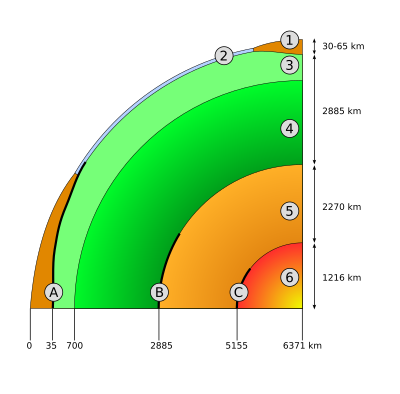
Pizza (2d) cutaway model of the Earth


The Innermost Frontier
Earth's inner core represents the planet's innermost geological layer, a distinct entity from the liquid outer core. It is characterized as a solid ball, a stark contrast to the molten metal surrounding it. Its radius is approximately 1,230 kilometers (760 miles), which constitutes about 20% of Earth's total radius.
To contextualize this, it is roughly 70% the radius of Earth's Moon. This immense metallic sphere is the ultimate destination of our planet's layered structure, a region of immense density and gravitational influence. Its existence and properties are foundational to understanding Earth's geodynamics and its evolution from its formation.
Thermodynamics of the Deep
The thermal conditions at the inner core's boundary are astonishingly extreme. Estimates place the temperature at its surface at approximately 5,700 Kelvin (5,430 °C or 9,800 °F). This temperature is comparable to, if not exceeding, the surface temperature of the Sun.
This intense heat is a remnant of the planet's accretion and differentiation processes billions of years ago, a vast reservoir of primordial energy. Despite this infernal heat, the inner core maintains its solid state, a phenomenon governed by the overwhelming pressure it experiences.
The Paradox of State
The solid nature of the inner core at such extreme temperatures is a direct consequence of the immense pressure exerted by the overlying layers of the Earth. The Simon-Glatzel equation, a thermodynamic model, describes how pressure can elevate the melting point of materials. In the case of the inner core, the pressure is so colossal that it forces the iron-nickel alloy into a solid crystalline structure, preventing it from melting.
This pressure is estimated to be around 3.6 million atmospheres. This interplay between extreme heat and extreme pressure is a critical factor in its physical state and its role within the Earth system.
Indirect Observation
Direct sampling of the inner core is impossible due to its extreme depth and temperature. Therefore, our understanding is derived from indirect geophysical methods. Seismic waves, generated by earthquakes, are the primary tool.
As these waves propagate through the Earth, their velocity, reflection, and refraction patterns provide data for seismic tomography, allowing scientists to image the Earth's interior. Variations in seismic wave speeds indicate changes in density and composition. Furthermore, the Earth's magnetic field, which shields the planet from harmful solar radiation, is believed to be generated by the convective motion of the liquid outer core, but the solid inner core plays a role in its dynamics and stability, possibly through heat flux.
Compositional Insights and Ongoing Research
The prevailing scientific consensus is that the inner core is composed primarily of an iron–nickel alloy. However, the exact proportions and the presence of lighter elements, such as sulfur, oxygen, or silicon, are subjects of ongoing research and debate. These lighter elements could influence the density and seismic properties of the core.
Understanding the precise composition is vital for refining models of Earth's formation, its thermal evolution, and the geodynamo that generates its magnetic field. Future research may involve more sophisticated seismic analysis and laboratory experiments simulating core conditions.
See also
Frequently Asked Questions
What is Earth's inner core?+
How hot is the inner core compared to the Sun?+
Why is the inner core solid even though it is so hot?+
How do scientists learn about the inner core if they can't sample it directly?+
What is the inner core made of and why do scientists study its composition?+
Based on content from Wikipedia · Licensed under CC BY-SA 4.0