

Earth's Wobbly Face!
Images

Moon Phases Over the Persian Gulf


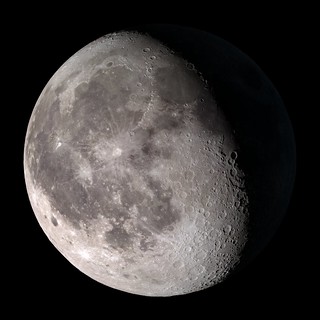
The Visual Spectrum of Earth from Lunar Orbit
The phenomenon of Earth phase refers to the varying appearance of the directly sunlit portion of Earth as observed from an extraterrestrial location, most notably the Moon. This is not an artistic representation but a direct astronomical observation dictated by the geometry of the Earth-Moon-Sun system. As the Moon completes its orbit around Earth, and Earth simultaneously orbits the Sun, the angle of illumination on Earth, relative to an observer on the Moon, continuously changes.
This results in a cyclical progression of Earth's visible illuminated area, analogous to, yet distinct from, the lunar phases we observe from Earth. The phases range from a 'new Earth' (when the sunlit side faces away from the Moon) to a 'full Earth' (when the sunlit side faces directly towards the Moon). Understanding Earth phases provides a unique perspective on our planet's illumination and its dynamic relationship with its celestial neighbors.
Orbital Mechanics
The cyclical nature of Earth phases is fundamentally driven by orbital mechanics. The Moon's orbit around Earth takes approximately 27.3 days (a sidereal month), but the phases are governed by the synodic month, which is about 29.53 days. This difference arises because while the Moon is orbiting Earth, Earth is also moving in its orbit around the Sun.
The synodic month measures the time it takes for the Moon to return to the same position relative to the Sun as seen from Earth, which is also the period over which Earth's phases, as seen from the Moon, complete a full cycle. The relative positions of the Sun, Earth, and Moon dictate how much of Earth's sunlit hemisphere is visible from the Moon. For instance, during a solar eclipse, when the Moon passes directly between the Earth and the Sun, an observer on the Moon would be experiencing an 'Earth eclipse,' seeing a dark Earth silhouetted against the Sun.
Earth as a Celestial Body
From the Moon, Earth appears as a significantly larger and more visually complex object than the Moon does from Earth. Its diameter is roughly four times that of the Moon, making it a dominant feature in the lunar sky. Earth's albedo, or reflectivity, is also much higher than the Moon's due to its atmosphere, oceans, and cloud cover, making it appear much brighter.
The phases of Earth are not merely geometric shifts in illumination; they also reveal the dynamic nature of our planet. Cloud patterns, ocean glints, and continental landmasses are visible, offering a constantly changing panorama. The observation of Earth phases from the Moon has been a profound experience for astronauts, providing a unique vantage point for appreciating Earth's beauty and fragility.
The Interplay of Lunar and Terrestrial Phases
There exists an inverse relationship between the phases of the Moon as seen from Earth and the phases of Earth as seen from the Moon. When we observe a full Moon, it signifies that the Moon is positioned between the Earth and the Sun, with the Earth facing the side of the Moon that is not illuminated by the Sun. From the Moon's perspective during this time, Earth would be in its 'new Earth' phase, as the sunlit side of Earth would be facing away from the Moon.
Conversely, when we see a new Moon, the Earth is between the Moon and the Sun, and the Moon's sunlit side is facing us. From the Moon, this corresponds to a 'full Earth' phase, where the entire sunlit hemisphere of Earth is visible. This reciprocal phasing underscores the fundamental geometric principles governing these celestial bodies.
Beyond the Moon
While the Moon is the most common extraterrestrial vantage point for observing Earth phases, the concept extends to any location beyond Earth. Spacecraft in orbit around Earth, or on missions to other planets, also observe Earth phases. These observations are not just visually striking but also scientifically valuable. For instance, studying the phases of Earth from different spacecraft can help scientists understand Earth's atmospheric composition, cloud cover distribution, and overall energy balance.
The continuous monitoring of Earth's phases from space has been instrumental in the development of Earth observation technologies and our understanding of climate science, providing a crucial long-term perspective on our planet's condition.
See also
Frequently Asked Questions
What are Earth phases?+
Why does Earth look different from the Moon?+
How long does one Earth‑phase cycle take?+
How big does Earth look from the Moon?+
What is an Earth eclipse?+
Based on content from Wikipedia · Licensed under CC BY-SA 4.0