

Digital Light Processing
Images
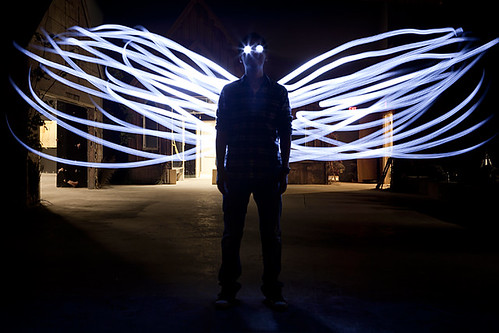
Light Painting


The DMD
At the heart of Digital Light Processing (DLP) lies the Digital Micromirror Device (DMD), a semiconductor chip that represents a pinnacle of micro-electro-mechanical systems (MEMS) engineering. Each DMD contains an array of hundreds of thousands to over eight million microscopic mirrors, each measuring only about 13.7 micrometers (0.00054 inches) across. These mirrors are mounted on tiny posts and can be precisely tilted by applying voltage to underlying circuitry.
The tilt angle is typically around 10-12 degrees, allowing the mirror to direct light either towards the projection lens (the 'on' state for a pixel) or into a light-absorbing area (the 'off' state). This rapid switching, occurring at speeds exceeding 1,000 times per second per mirror, is fundamental to DLP's performance. The ability to control each pixel's light output individually and with such speed enables the creation of highly detailed, bright, and fluid images.
The robustness of these mirrors, designed to withstand billions of switching cycles over their lifespan, is a testament to the advanced materials science and manufacturing processes involved.
Color Generation and Image Formation in DLP Systems
DLP technology achieves color reproduction through sophisticated light manipulation. The most common DLP systems employ a single DMD chip, which necessitates a color wheel to generate full-color images. This wheel, containing segments of red, green, and blue filters, spins rapidly in front of the light source.
As the light passes through the color wheel and illuminates the DMD, the mirrors for each pixel tilt to reflect the appropriate color of light towards the lens at the correct moment in the color wheel's rotation. The human visual system then integrates these rapidly presented red, green, and blue images into a single, full-color picture. For applications demanding superior color accuracy and brightness, such as high-end cinema projectors, three-chip DLP systems are used.
These systems split the white light into red, green, and blue beams using prisms, with each beam directed to its own dedicated DMD chip. The reflected light from each DMD is then recombined to form the final image, offering richer colors and higher contrast ratios by eliminating the need for a color wheel and its associated limitations.
The Transformative Impact and Applications of DLP
Digital Light Processing has fundamentally reshaped how we experience visual information, moving beyond traditional display methods. Its most prominent application is in digital cinema projectors, where DLP technology is the standard, enabling the projection of high-resolution, bright, and consistent images that define the modern movie-going experience. In the consumer electronics market, DLP powers many high-definition home theater projectors, offering an immersive cinematic environment.
Beyond entertainment, DLP finds critical use in business and education for presentations, where its brightness and clarity ensure visibility even in ambient light. Furthermore, DLP technology is integral to industrial applications, including 3D printing (stereolithography), where precise light patterns are used to cure resins layer by layer, and in advanced scientific instrumentation for spectroscopy and light manipulation. The technology's scalability and adaptability have allowed it to penetrate diverse fields, driving innovation and enhancing visual fidelity across the board.
From Concept to Commercialization
The journey of Digital Light Processing from a theoretical concept to a ubiquitous technology is a compelling narrative of scientific ingenuity and commercial development. The foundational patent for the DMD was filed by Larry Hornbeck of Texas Instruments (TI) in 1987, envisioning a solid-state light modulator that could replace bulky cathode ray tubes. The initial development phase involved overcoming significant engineering challenges related to mirror control, heat dissipation, and manufacturing scalability.
TI officially introduced the first DLP products in the mid-1990s, initially targeting high-end projection systems. Early adoption in digital cinema was pivotal, with DLP becoming the dominant technology for digital movie projection systems that began replacing film projectors in the early 2000s. Continuous advancements have focused on increasing resolution, improving brightness and contrast ratios, enhancing color accuracy, and reducing the size and cost of DLP chips and projectors.
This ongoing evolution underscores DLP's enduring relevance and its capacity to adapt to emerging display requirements.
See also
Frequently Asked Questions
What is Digital Light Processing?+
How do the tiny mirrors in a DLP projector work?+
Why do DLP projectors use a color wheel?+
Where else is DLP technology used besides movie theaters?+
How many mirrors are on a DLP chip?+
Based on content from Wikipedia · Licensed under CC BY-SA 4.0