

Dictatorship: When One Person Rules Everything!
Images

“I mean, how do you build a dictatorship? First, you undermine the press: ‘The only truth you’re going to hear is from me’.” ―David Letterman ⚔️
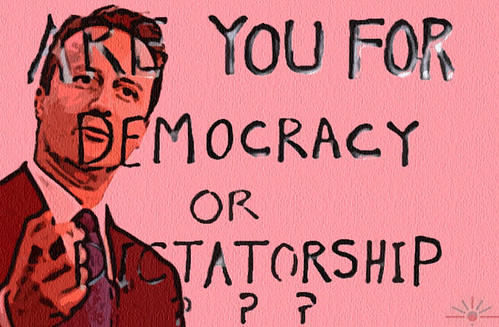


The Monolithic Grip
A dictatorship represents a form of government distinguished by a leader, or a concentrated group of leaders, wielding absolute or near-absolute political authority. Unlike democratic systems where power is distributed and accountable to the populace, dictatorships centralize control, often bypassing established legal frameworks or manipulating them to serve the ruler's interests. The political landscape is dominated by the dictator and their inner circle, comprising advisors, military commanders, and other elites who facilitate the regime's operations.
Maintaining this absolute power is a constant endeavor, involving the careful appeasement of this inner circle while simultaneously repressing any form of opposition. This opposition can manifest as rival political parties, armed resistance movements, or even internal dissent within the ruling elite. The very essence of dictatorship lies in the unchecked accumulation and exercise of power, often at the expense of individual liberties and democratic principles.
From Roman Expedience to 19th Century Consolidation
The term 'dictator' has ancient roots, originating in the Roman Republic where it denoted a temporary constitutional office granting absolute power to a leader tasked with resolving critical emergencies. This historical precedent, however, stands in stark contrast to the modern concept of dictatorship. The 19th century witnessed the emergence of modern dictatorships, exemplified by Bonapartism in Europe and the rise of caudillos in Latin America.
These figures consolidated power through various means, often leveraging military strength or populist appeal. The advent of the 19th and 20th centuries saw dictatorships solidify as a major global form of government, often developing in parallel with constitutional democracies and gradually eclipsing traditional monarchies. This period marked a significant ideological and structural shift in governance, laying the groundwork for the diverse forms of authoritarian rule seen today.
The Architecture of Control
A hallmark of dictatorial regimes is the systematic suppression of freedom of thought and expression. This is not merely incidental but a foundational strategy for maintaining political and social supremacy. Dictatorships actively work to control the narrative, employing sophisticated propaganda machinery to disseminate their ideology and discredit alternative viewpoints.
This can involve censorship of media, manipulation of educational curricula, and the creation of a climate of fear that discourages open criticism. The goal is to create a populace that is either compliant or actively supportive of the regime, thereby solidifying its stability. The restriction of information flow is crucial, preventing citizens from accessing diverse perspectives that might challenge the established order or inspire organized resistance against the ruling power.
Mechanisms of Perpetuation
The longevity of dictatorships often hinges on a complex interplay of coercion and co-optation, frequently masked by a democratic facade. While elections may be held, they are typically non-competitive, serving to legitimize the regime domestically and internationally rather than offering genuine choice. Stability is maintained through pervasive political repression, which includes surveillance of opposition groups, restriction of access to information, and the potential for violent enforcement.
Dictatorships may also co-opt potential rivals by offering them positions within the ruling elite, thereby neutralizing threats and fostering loyalty through patronage. Failure to effectively manage these mechanisms can lead to the regime's collapse, often through coups or revolutions, highlighting the inherent fragility beneath the veneer of absolute control.
The Evolving Landscape
The 20th century was a crucible for dictatorial ideologies, witnessing the rise of potent forces like fascism and communism. Fascist dictatorships, largely eradicated after World War II, gave way to the global spread of communism, which persisted until the Cold War's end. Concurrently, personalist and military dictatorships gained prominence in Africa and Latin America during the latter half of the century. The post-Soviet era saw a surge in democratic transitions, yet dictatorships have persisted and, in recent years, have seen a resurgence.
The early 21st century initially favored democracies, but a 'democratic recession' following the 2008 financial crisis saw authoritarian states regain ground. Today, dictatorships continue to adapt, leveraging new technologies for surveillance and control, posing ongoing challenges to global democratic norms and human rights.
Go deeper
Frequently Asked Questions
What is a dictatorship?+
Why do dictators try to control the news and schools?+
How do dictators keep people from fighting back?+
When did dictatorships become common?+
Is a dictatorship the same as a king?+
Based on content from Wikipedia · Licensed under CC BY-SA 4.0